Part 1 of The State of DHCW. DHCW's founding rationale was the failure of NWIS: in 2018 the Auditor General found only seven of 30 projects on target, and the Public Accounts Committee found 'a culture of self-censorship and denial.' The Welsh Government's escalation record then moves in one direction — Level 1 with strengthened oversight in October 2024, Level 3 in March 2025, Level 3 held in December 2025, and Level 4 'targeted intervention' for the whole organisation in April 2026, with the full charge sheet published verbatim.
Part 1 of The State of DHCW, the documented record of Digital Health and Care Wales. Numbered citations resolve at the sources page.
The inheritance: what DHCW was created to fix
DHCW’s founding rationale was failure. In January 2018 the Auditor General for Wales reported on informatics systems in NHS Wales and found that of 30 NWIS projects in roll-out, only seven were on target, with some counted as “on track” only against revised dates. His conclusion was blunt: “many of the national systems are significantly delayed and probably cost more than expected. The exact scale and cost of the delay are difficult to quantify.”[18] He also found “significant weaknesses in NWIS’ governance arrangements including a lack of independent scrutiny and unbalanced reporting of progress,” described the hosting arrangement under Velindre NHS Trust as “unsatisfactory,” and identified “a lack of clarity as to responsibility for delivering the intended benefits of national informatics systems and a lack of monitoring.”[18]
The Senedd Public Accounts Committee’s November 2018 report went considerably further. Its chair’s foreword is worth quoting at length because it establishes the baseline against which DHCW must be judged:
“In 2003 the iPhone was yet to be invented … It was in this same year that the Informing Healthcare strategy was launched, with an electronic patient record for Wales at its heart. The other technological innovations of that year have not only been realised, but leapfrogged several times, and yet NHS Wales remains far away from a seamless electronic portal for patient records. … Our inquiry has raised serious question marks about the competence, capability and capacity across the health system to deliver a digital transformation in Welsh healthcare. And yet we discovered a culture of self-censorship and denial amongst those charged with taking the agenda forward … We believe it’s time for a reboot.”[21]
The Committee’s formal findings included that “the culture at NWIS was the antithesis” of the open culture digital transformation requires; that witnesses “were reluctant to be critical of progress or arrangements on the record”; that “the Committee could have little confidence in many of the assurances we were given by NWIS and the Welsh Government”; and that it had “deep concerns about the capacity of the leadership team to deliver the scale of change required.”[21] It recorded 21 major system outages in the first six months of 2018 — one every nine days — and recommended “a review of the senior leadership capacity in terms of skillset and governance.”[21] It noted that just 10% of NWIS activity was directed at innovation, and that the tentative cost of delivering the electronic patient record vision was £484 million on top of existing budgets.[21]
The Welsh Government’s answer was structural. Two independent reviews — a Digital Governance Review and a Digital Architecture Review — led to a September 2019 written statement announcing that NWIS would become a Special Health Authority, supported by an additional £50 million and actions to “strengthen digital delivery and planning across the system.”[6] DHCW was established on 1 April 2021.[7]
The transition itself was not smooth. NWIS director Andrew Griffiths stepped down on 5 November 2019, the day after giving evidence to the Public Accounts Committee; the Committee chair wrote to the Welsh Government stating “I would have expected the Committee to have been advised of this.”[24] The substantive chief executive recruitment had to be re-advertised, so DHCW launched with an interim chair (Bob Hudson) and an interim chief executive (Helen Thomas, previously interim director of NWIS), with Thomas confirmed substantively in May 2021.[25][7] Continuity of leadership from the criticised predecessor body was therefore built into the new organisation from day one — a fact that becomes material in Part 3 and Part 6.
The escalation ladder, 2024–2026
The single most authoritative index of DHCW’s delivery record is its position on the Welsh Government’s NHS Wales oversight and escalation framework. That record is unambiguous and moves in one direction.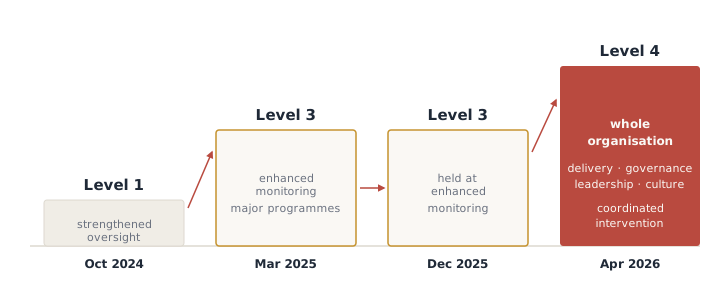
The official escalation history is as follows.[1]
| Date | Level | Welsh Government's stated basis |
|---|---|---|
| Oct 2024 | Level 1 with strengthened oversight | "a letter indicating the DHCW Board need to take action to improve deliverability and confidence in DHCW system partners" |
| Mar 2025 | Level 3 — enhanced monitoring | "performance and outcomes related to the delivery of major programmes"; the first escalation in DHCW's history[2] |
| Dec 2025 | Level 3 — retained | "Remained in level 3 with enhanced monitoring of performance and outcomes related to the delivery of major programmes" |
| Apr 2026 | Level 4 — targeted intervention | "the whole organisation due to increasing concerns related to performance, programme delivery, governance, stakeholder and leadership challenges" |
The March 2025 escalation
Announcing the first escalation to the Senedd on 11 March 2025, the then Cabinet Secretary for Health and Social Care, Jeremy Miles, said: “I am making this decision because of serious concerns about the organisation’s ability to effectively deliver a number of major programmes. It is vital the NHS has confidence in DHCW to deliver our digital transformation.” He added that “Level 3 is the first stage of significant intervention” and that the Welsh Government would engage “additional digital expertise” to provide “an independent assessment of DHCW’s ability to deliver.”[54]
The published framework listed nine programme areas in which DHCW “must agree and deliver the core milestones”: national enterprise architecture; the Digital Services for Patients and Public Programme including the NHS Wales App; Connecting Care; data architecture including the National Data Resource; the diagnostics programmes (RISP and LIMS); primary care including the migration off Cegedim VISION; digital medicines and prescribing; intensive care (“undertaking an assessment on the next steps for this programme”); and the Cancer Informatics Programme.[2] DHCW responded by naming its Director of Corporate Affairs / Board Secretary as lead and producing a plan with 42 milestones.[12]
The April 2026 escalation to Level 4
The Level 4 decision followed Welsh Government assessments in June and November 2025. The framework states that the escalation reflects “serious and systemic concerns requiring coordinated Welsh Government intervention,” and that while “there are many areas within the organisation that are working effectively,” “across the organisation … assessment and support is required for programme delivery, governance, leadership and culture.”[1]
Because the Welsh Government’s own list of concerns is the most direct statement of the case against DHCW available anywhere, it is set out in full below, grouped as published.[1]
| Domain | High-level concerns, April 2026 (verbatim) |
|---|---|
| Performance and outcomes | repeated failure to deliver major programmes to plan · limited benefits realisation despite sustained investment · delivery confidence weakened by repeated resets and reprofiling · misalignment between milestones and operational readiness · national delivery delays impacting health board planning · leadership capacity absorbed by recovery activity |
| Governance, leadership, workforce and culture | insufficient delivery grip and realism in leadership behaviours · late identification and escalation of risk · focus on milestone delivery over system outcomes · weak system engagement and co-ownership with health boards · reduced system confidence in delivery reliability · capacity and capability not aligned to portfolio scale and complexity · over-reliance on key individuals · unsustainable workforce model (temporary and external roles) · limited flexibility to respond to emerging priorities · growth not matched by delivery maturity · erosion of confidence across health boards and partners · reduced credibility of national digital commitments · increased external scrutiny and reputational risk · risk of disengagement from future national programmes |
| Finance, strategy and planning | continued investment without commensurate delivery · weak alignment between funding and delivery confidence · limited portfolio-level financial grip · insufficient use of stop or reset mechanisms · lack of long-term financial sustainability clarity |
Annex 1 of the framework expands these with named examples. On culture, it states that “senior leadership has not consistently modelled a strong delivery culture grounded in realism, early escalation and decisive action (for example, optimism bias and late challenge emerging around recovery confidence in major programmes such as the NHS Wales App and diagnostics),” and that “cultural factors appear to inhibit early, open reporting of delivery risk, dependencies and confidence, resulting in issues surfacing at the point of impact rather than through proactive management.”[1]
On key-person risk it records that “key programmes and assurance functions depend on a small number of individuals, creating single points of failure … discussions repeatedly highlighted reliance on specific programme, clinical safety and architecture leads, with progress slowing when these individuals were unavailable or diverted to urgent priorities.”[1] On growth, it observes that “significant growth in scope, staffing and funding has not yet resulted in a commensurate improvement in delivery maturity or outcome,” noting that the shift from a “milestone-heavy” 2025–26 remit to an outcome-focused 2026–27 remit “reflected recognition that increased activity had not improved delivery confidence.”[1]
The intervention has two phases. Welsh Government has commissioned NHS Wales Performance and Improvement’s Intensive Support, Recovery and Turnaround (ISRT) function. Phase 1 is an 8–12 week independent evaluative review of “the underlying causes … with a specific focus on programme management, governance, organisational culture and leadership,” to be undertaken “by independent and suitably skilled individuals … to support understanding of the underlying cultural dynamics within the organisation.” Phase 2 terms of reference follow. Oversight sits with an Escalation Board chaired by the NHS Wales Chief Executive and Director General for Health, Care and Prevention, with ministerial oversight and monthly performance reviews.[1] The mechanism, the precedents and what to expect from it are examined in Part 7.
Status. The Level 4 framework was first published on 9 July 2026. No completed or published ISRT Phase 1 report was traceable as at 30 July 2026; on the published timetable it would report between roughly September and October 2026. De-escalation requires sustained progress over two consecutive quarters and moves one level at a time — so the earliest realistic return to Level 3 is mid-2027.[1]