The Whistleblower Suppression Loop
Raise a concern. Lose your career. Everybody watches.
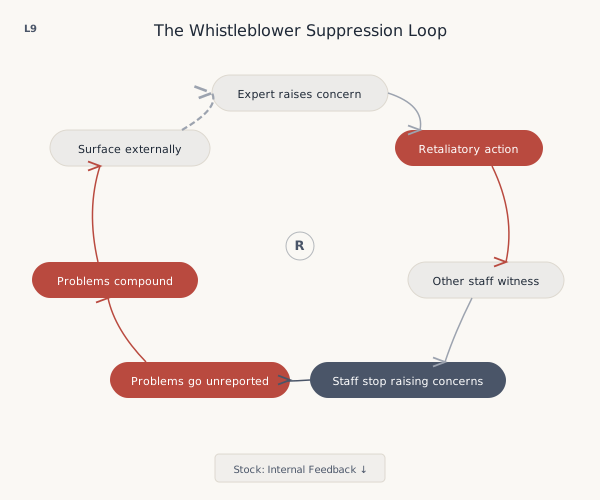
When people raise legitimate concerns at Digital Health and Care Wales (DHCW), the organisation tends to manage the person rather than the problem. Those who flag technical, delivery or integrity risks find themselves moved onto disciplinary or performance routes rather than heard; capable people leave; and the board is left with a curated account. The system does not merely fail to listen — it discourages the very people whose role is to surface what the organisation needs to hear, which is why internal correction never reaches the delivery failures in Cluster A.
A technical expert raises a legitimate concern about delivery failures, financial waste, or patient safety.
What is the Whistleblower Suppression Loop at DHCW?
The concern-raiser is sidelined rather than heard — moved onto a disciplinary or performance track, isolated, and managed out. The problem they named leaves with them.
Other staff watch. The lesson is clear: raising concerns is career-ending. Staff stop raising concerns. Problems go unreported. The board receives only curated information. Problems compound invisibly until they surface externally — through Senedd scrutiny or patient safety incidents.
The loop’s speed is what distinguishes it: each visible retaliation produces an immediate chilling effect across the remaining workforce. No gradual erosion is needed.
How It Manifests at DHCW
Suppression need not be universal; it needs only to affect enough people, visibly enough, that the rest silence themselves. Staff who raised concerns about technical capability, programme realism, or the integrity of the published record were, in my experience, managed out through disciplinary and performance processes rather than heard — and others drew the obvious lesson.
The official story is kept up with care. The board’s champion for raising concerns reported the staff “ability to speak up” score as “a relatively positive score, and we’ve done some proactive work to promote this” — one unsourced sentence, at the meeting that buried the 65% burnout figure and nodded the pledge through. When an external cultural review of the whistleblowing culture was finally completed, the findings went unpublished — actions to be “revealed on a biannual basis until they are complete,” the board told only that feedback was “positive” and arrangements “robust,” two months before Welsh Government escalated the organisation for, among other things, its culture. What the review found, the public never learned; “positive” was the committee’s word, not a published finding.
The numbers are the proof of the silence. DHCW publishes no whistleblowing figures, no disciplinary outcomes, no leaver analysis; its own data shows just four raising-concerns cases in 2024–25 across an average of some 1,235 staff, and two the following year. What staff actually think escapes only where the organisation cannot edit it — anonymous Glassdoor reviews, which the employer cannot remove, describing a “horrendous culture of bullying… sweeping any issues under the carpet.” That is the loop’s achievement: not a purge but a settled silence, in which the people likeliest to spot a problem early have learned that naming it is the fastest way to become one.
What would a healthy alternative look like?
Concern-raisers are protected by statute. Their information reaches governance bodies through a channel that cannot be intercepted by the people the concern is about. Whistleblowing data is published annually. Disciplinary processes are audited for patterns of retaliatory use. When someone raises a concern and is then subjected to disciplinary action, the coincidence triggers automatic independent review.
How does the blueprint break the Whistleblower Suppression Loop?
Retaliation cannot be stopped by the leadership conducting it. Competent Leadership removes the leadership under which disciplinary and performance processes were turned against technical dissent, and installs leadership accountable under externally verifiable criteria. Only after that substitution does it become possible to restore the internal feedback capacity that whistleblower protections are supposed to guarantee.