Blueprint Digital NHS WalesThe DiagnosisL8: The Loyalty Selection Loop·Cluster B
Feedback Loop 8

The Loyalty Selection Loop

The organisation grows. Competence shrinks. Control tightens.
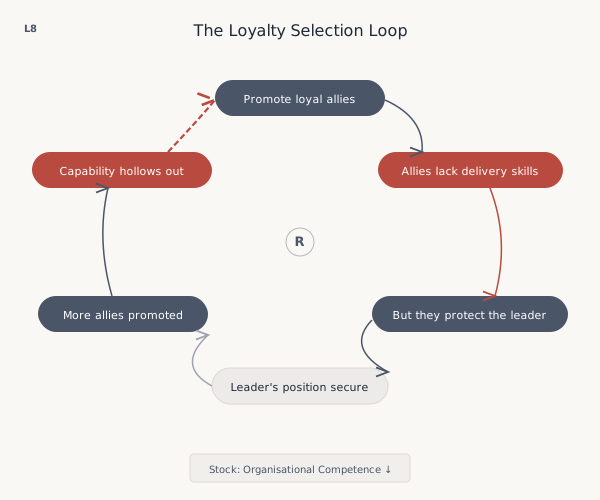
Type Reinforcing (vicious) Cluster B — Self-preservation Stock depleted Organisational Competence Delay Cumulative — each loyalty hire reduces average capability
Causal loop diagram for L8: The Loyalty Selection Loop

DHCW leadership was pre-selected from an ABUHB patronage pipeline four months before DHCW's founding board met. Three executive directors received UWTSD Professor of Practice titles in December 2020; three successive NHS Wales CEOs have been drawn from a single health board via Goodall and Paget. Promotion inside DHCW continues to favour loyalty over capability. Capability voices exit; the selection bias deepens with every cycle; the executive cohort grows more uniform, more loyal, and less able to deliver.

Promote loyal allies over competent candidates. The allies cannot deliver — but they are loyal. They protect the leader from accountability. They don’t challenge bad decisions. The leader’s position becomes more secure, so more allies are promoted. Delivery capability hollows out while the control structure solidifies.

The organisation grows. Output shrinks.

What is the Loyalty Selection Loop at DHCW?

Structural dysfunction distributes harm randomly. Patronage distributes harm systematically toward those who threaten the clique’s position, and benefit systematically toward those who protect it.

The beneficiary test is the diagnostic: in every decision where delivery is sacrificed, the same small group benefits. The concentration of benefit runs always in the same direction, and always at the expense of the same category of person.

How It Manifests at DHCW

The selection pattern predates DHCW. Leadership was pre-selected from a patronage pipeline controlled by Andrew Goodall (Welsh Government Permanent Secretary, formerly ABUHB CEO) and Judith Paget (Director General Health & Social Services, formerly ABUHB CEO). Three successive NHS Wales CEOs emerged from a single health board. The pipeline operated during the NWIS era and was imported into DHCW as part of the structural continuity documented at Why this Blueprint, section 1 — “a thinly-repainted NWIS.” The selection pattern is not a corruption of the design; it is the design.

In December 2020 — four months before DHCW’s founding board meeting — Helen Thomas (CEO), Rhidian Hurle (Medical Director), and Ifan Evans (Executive Director Strategy) were awarded “Professor of Practice” titles by the University of Wales Trinity Saint David, via its Wales Institute of Digital Information (WIDI). The titles were never declared at any board meeting, despite the Chair asking for declarations of interest at every meeting opening.

The pattern is quantified across the full timeline. The knowledge graph documents 33 instances where directors declared “nil” while holding undisclosed Professor of Practice titles — Thomas 10, Evans 10, Hurle 8, Hall 5 — and 45 further instances of undeclared interests at specific meetings. At the very first board meeting (April 2021), Thomas had held the title for 10 months. She declared nil. The Chair’s invitation — “Any declarations?” — was met with “No” or “None” at every meeting through to escalation.

This is not deterioration. It is the default configuration from day one.

Multiple independent witnesses describe sham recruitment for key senior roles below the executive: competitive processes conducted as performance theatre while outcomes were predetermined. Selection criteria were reverse-engineered to match specific candidates. External candidates with stronger qualifications were rejected in favour of internal loyalists.

The beneficiary test applies directly: in every DHCW decision where delivery was sacrificed, the same small group benefited — the circle around the CEO — and always at the expense of the same category of person: technical staff who raised concerns. That is not dysfunction. It is patronage.

The Head of Software Engineering – the most senior hands-on technical role in a national health IT organisation – was advertised at Band 8c (£71-82k). This is well below market rate for equivalent responsibility in the private sector, other NHS organisations, or UK government digital. Either the role was designed for a predetermined internal candidate, or the process was never serious about attracting external talent. Both lead to the same place.

The CEO accumulated a BCS Fellowship, FedIP registration, the UWTSD Professor of Practice title, and a “Digital CEO of the Year” award — all during the 2020-2021 transition to the permanent CEO role. Multiple internal sources confirm she encouraged staff credential accumulation, reframing institutional positioning as organisational culture.

Meanwhile, directors without disclosed academic qualifications occupy senior technical roles. The pattern is consistent: credentials and advancement flow along loyalty lines.

The Senedd noted in July 2023: “It was not clear to us which skills or departments have been prioritised” in the workforce expansion. When asked what patient benefit corresponded to a 25% workforce increase, the CEO replied: “It would be lovely to sit here and be able to demonstrate the value.”

The CEO of a technology delivery organisation could not name a single patient outcome from hiring hundreds of additional staff.

The selection pattern extends beyond permanent staff. 23 off-payroll workers operate as a shadow workforce, making healthcare decisions outside normal accountability structures — invisible to governance scrutiny.

The pipeline continues. Ifan Evans authored A Healthier Wales — the Welsh Government strategy DHCW was created to implement — and was seconded to DHCW to oversee its implementation. The implementation has not been delivered. He is now designing the “Blueprint”: the next 10-year digital strategy for NHS Wales. The people who failed at the originating health board were promoted to oversee DHCW, where they presided over the same failures. The pipeline that created the leadership structure remains intact.

The loyalty selection loop creates the conditions for every other Cluster B loop. L7: The Competence Void exists because loyalty, not competence, determines who leads. L9: The Whistleblower Suppression Loop operates because loyalists control HR. L10: The Information Fortress holds because loyalists control communications. L11: The Oversight Obstruction Loop works because loyalists occupy the positions through which oversight flows. L8 is the root of the self-preservation engine.

What would a healthy alternative look like?

Recruitment is competitive, transparent, and externally auditable. Selection criteria are published before shortlisting. Panel members include external specialists. Outcomes are documented and challengeable. Salaries reflect market rates for the role’s actual responsibility. When governance is not captured, hiring optimises for the organisation’s mission — not for the leader’s control.

How does the blueprint break the Loyalty Selection Loop?

Loyalty selection cannot be unwound by the people it put in place. Competent Leadership removes the selectors: externally run executive recruitment against published criteria, replacing the leadership layer that converted appointment power into a patronage network. Only after that substitution does it become possible to rebuild hiring below the board as merit-based rather than loyalty-based.