The Competence Void
Leaders who can't evaluate what they're leading.
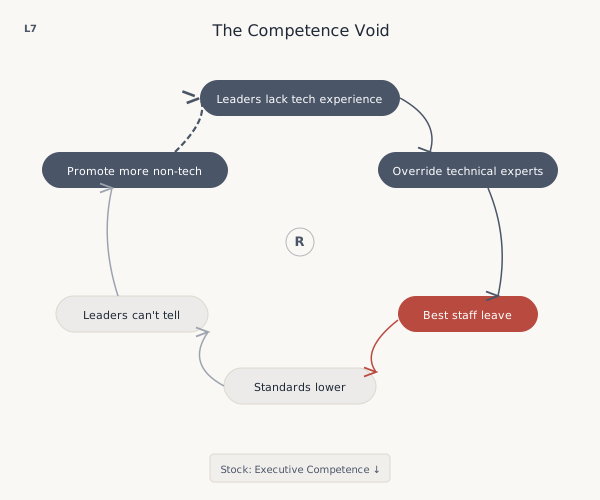
Digital Health and Care Wales (DHCW) is a technology-delivery organisation led by executives with no complex technology delivery experience. The senior team carries no patents, no operational scaling credentials, no national-scale software delivery track record. The structural consequence: the organisation cannot ask itself the right technical questions, cannot evaluate vendor claims independently, and cannot tell the difference between a programme in trouble and a programme that has crossed into unrecoverable. The void is not a skills gap — it is an inability to detect that there is a gap.
DHCW is a technology delivery organisation. Its leadership team has no complex technology delivery experience.
What is the Competence Void at DHCW?
When leaders lack technical experience, they cannot evaluate technical recommendations. They override experts with uninformed decisions. The best technical staff learn that expertise does not matter. They leave. Remaining staff lower their standards. The void deepens.
The delay is the killer: existing systems run on legacy knowledge and momentum for years before the consequences surface. By the time leadership’s inability is visible externally, the people who could have prevented the collapse have already left.
How It Manifests at DHCW
DHCW is a technology-delivery organisation whose leadership has never successfully delivered complex technology at scale. The chief executive describes her own ascent as accidental — “there was never a plan for that,” she has said — and her signed COVID Inquiry statement records a career that began “initially working in finance, moving into health information in 2000.” Her one technology-adjacent qualification, a master’s in health informatics, is not a record of building or running systems. The strategy director is a historian by training, with no technology or computing credential identified; he authored Welsh Government’s digital strategy and was then seconded into DHCW to execute it. The rest come from local government and administration. When England’s NHS Digital set out to build at national scale it recruited from Credit Suisse, HSBC, the Home Office, Jaguar Land Rover and Rolls-Royce.
The gap was named early and ignored. In DHCW’s fourth board meeting, the one member with private-sector technology experience warned that the cloud transition needed skills that “don’t exist today” and urged the executive to “bring in somebody… from the private sector… for some knowledge transfer.” It was never actioned. The Chair later admitted the executive team itself took “not far off two years” to assemble. None of this slights able people; it is a question of which ability. The DHCW team is good at what it has always done — governance documents, Senedd committees, annual reports, and performance theatre. What none has done is deliver a complex technology programme at scale. No organisation can judge, challenge or steer work its leaders do not understand. That is the whole void: not missing ability, but ability aimed at the wrong thing.
What would a healthy alternative look like?
Leadership roles in a technology delivery organisation require demonstrable technology delivery experience — verified by independent skills audit, not self-reported. Board recruitment is conducted by external panels with published criteria. When NHS Digital England needed to deliver at scale, it recruited C-suite leaders from Credit Suisse, HSBC, and Rolls-Royce. Governance ensures the people making technical decisions have the competence to evaluate them.
How does the blueprint break the Competence Void?
No internal initiative can fix a competence void in the leadership that would run it. The entry point is Competent Leadership: the leadership producing the failure must be replaced by leadership capable of delivery, selected by an external panel against published technical criteria. Every other intervention depends on this, because every other intervention requires leaders who can evaluate it.