The Manufactured Narrative
80% satisfaction. Level 3 escalation. Both true. One manufactured.
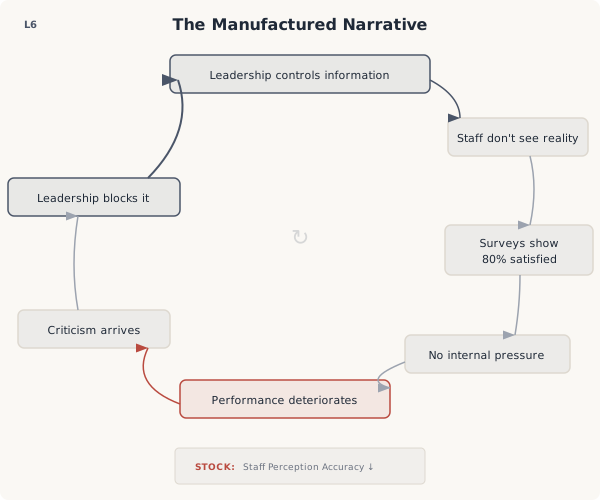
Digital Health and Care Wales (DHCW) reported 80% staff satisfaction while under Level 3 enhanced monitoring. Internal perception is actively managed: board reports filter through layers of presentation polishing, dissent is reframed as 'culture', performance data is selected for narrative fit; published board minutes contain as little as 10–16% of the actual meeting content. The gap between the published version and the operational reality widens year on year — and the manufactured narrative makes the gap invisible to almost everyone outside the building.
DHCW reported 80% staff satisfaction. DHCW was under Level 3 enhanced monitoring for serious delivery failures — and in April 2026 was escalated to Level 4. Both statements are true. They are not contradictory — if you understand the mechanism: leadership actively controls the information available to staff.
What is the Manufactured Narrative at DHCW?
A manufactured narrative is not a cultural bubble where staff are organically insulated from reality through awards and institutional pride. It is actively produced. Information that would contradict leadership’s story is blocked, unpublished, or reframed. Information that supports the story is amplified.
The manufactured narrative prevents the internal pressure that would otherwise force change. When staff believe the organisation is performing well, they don’t demand accountability. When they don’t see external criticism, they don’t question leadership decisions.
How It Manifests at DHCW
DHCW reports 80% staff satisfaction while 65% are burnt out (both from the same July 2024 survey), mid-escalation. What the board says in the room and what appears in the minutes are two different documents — produced, latterly, “with the support of Co-pilot,” though the curation predates the tool by years. The scale is counted: 107 documented sanitisation instances and 237 further passages identified as hiding-intent across the published board and committee record. At the extreme, a four-hour September 2022 session was published at a curation ratio of 8.6% — fewer than one word in eleven, with fifteen of nineteen speakers absent from the record entirely. The edits run one way. When the chief executive called a repeat data-centre failure what it was — “this should really be a never event” — the minutes recorded that “the Board expressed appreciation for the transparency of the presentation”; the operations director’s admission that “we did have another incident like this last year” simply vanished.
The inversions get bolder. After the escalation, an independent member’s “initial disappointment and frustration” became, in the minutes, a bold subheading: “Positive Engagement.” A funding warning that the model was “antithetical to us being able to deliver” was filed as “concern about financial uncertainty noted.” And at his final meeting the outgoing chair disclosed that “I’ve… written to the Auditor General to express my concerns” about Welsh Government’s role — the single most significant statement in the series, rendered in the minutes as a man who “thanked the Executive team.” The reflex reaches the values, too: a Compassionate Leadership Pledge was carried in seconds — “are people happy to approve the signing of that pledge? Lovely” — no discussion, in the same meeting that buried the burnout figure.
So the 80% is not a finding about a contented workforce. It is an output of the same machine — a record an organisation has arranged so that nothing contradicting it survives to the page.
What would a healthy alternative look like?
Staff have unrestricted access to all public information about their organisation. Satisfaction surveys are published alongside externally assessed delivery metrics — if the two diverge, governance investigates why. No public information source is blocked on internal networks. The gap between internal narrative and external reality is measured and closed, not manufactured.
How does the blueprint break the Manufactured Narrative?
The narrative is only manufacturable because contradictory information can be suppressed. Radical Transparency publishes the inputs the narrative relies on hiding — whistleblowing counts, disciplinary data, leaver analysis, delivery status against commitments. Once those flow at statutory cadence, internal perception re-anchors to external reality, and the satisfaction-survey-to-Level-3-escalation gap becomes impossible to maintain.