The Vendor Dependency Spiral
£1.25 billion in contracts. Declining leverage with each one.
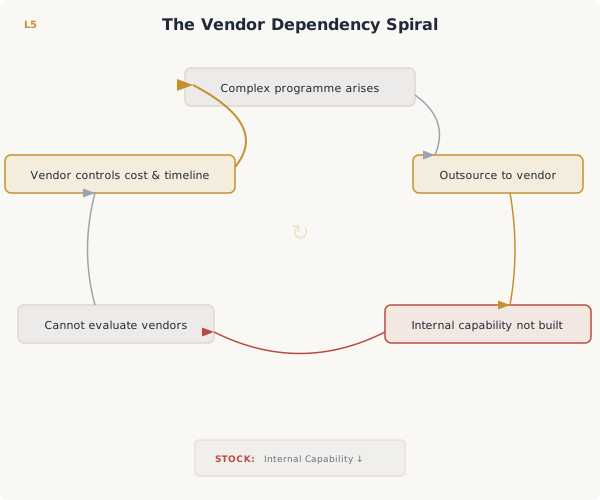
Digital Health and Care Wales (DHCW) manages a vendor portfolio valued at approximately £1.25 billion. Each outsourced capability deepens dependence on the vendor; internal capacity to validate vendor claims atrophies; the next strategic decision is made with less independent technical judgement than the last. The board-level procurement record shows the pattern: frameworks approved unread, the largest agreement in the organisation's history decided outside the public forum.
When a complex programme arises, the path of least resistance is to outsource it. But outsourcing does not build internal capability. Without internal capability, you cannot evaluate vendor performance or negotiate from strength.
What is the Vendor Dependency Spiral at DHCW?
The vendor controls timeline and cost. When the next programme arises, you outsource again – because you still lack the capability you never built. The portfolio grows. The leverage shrinks.
Each outsourced programme reduces the internal skill pool available to assess the next contract, which makes the next contract more likely to be outsourced on worse terms.
How It Manifests at DHCW
DHCW runs a £1.25 billion contract book and barely reads what it signs. The chair’s own admissions — a framework approved unread, the organisation’s largest-ever agreement decided outside the public forum — are on the governance record. And the chair named the pattern himself: “we do go through this conversation every few years.”
The terms are kept dark and the competition is theatre. The supplier on a £47M radiology deal (Philips) surfaced only at a one-item extraordinary board, never in the annual report or the published procurement register. A £10M workforce framework drew two tenders per lot and not a single bid from a small or medium supplier — and the same handful of names (Kainos, TPXimpact, Trustmarque) recur across frameworks. Internal audit logged the consequence as recurrence: a “third strike” of procurement non-compliance, including retrospective call-offs to Kainos (£390,000) and TPXimpact (£271,000).
The cause is simple. An organisation that cannot build can only buy, and DHCW has bought so long that consultants no longer supplement its workforce — they stand in for one that does not function. None of it is forced: Denmark and Estonia built modern health infrastructure on smaller budgets by backing their own people and running real competitions. The dependency is a product of incompetence.
What would a healthy alternative look like?
Every outsourced programme includes a mandatory knowledge transfer plan and internal capability build. Contract values are published. Vendor performance is assessed independently. Sole-bidder contracts trigger automatic governance review. Internal technical teams retain enough capability to evaluate vendor claims and negotiate from strength.
How does the blueprint break the Vendor Dependency Spiral?
The spiral only unwinds when the default choice flips from “outsource” to “build”. Flip the Model rebuilds internal technical capability as the primary delivery mechanism, with vendors used for bounded specialist work on published terms. As in-house competence rises, the organisation regains the ability to evaluate vendor claims — which is the precondition for every other procurement and contract reform.