The Rebranding Escape
Fail. Rename. Repeat. Learn nothing.
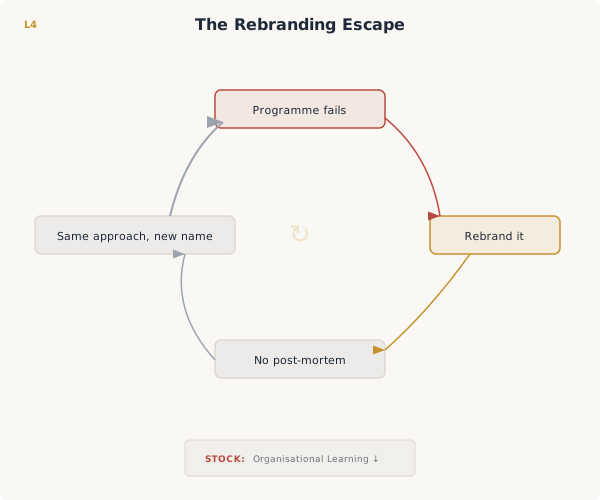
When a Digital Health and Care Wales (DHCW) programme fails, it is renamed rather than fixed. New name, new slides, same architectural problems, same delivery team. Programmes have moved through three or four names without the underlying problem being addressed — the rebrand IS the response to failure, because the rebrand resets the public clock and the internal narrative without requiring any technical change to the system that was failing.
When a programme fails, the instinctive institutional response is not to understand why. It is to rename it. New slide deck, same team, same structural problems. The rebrand absorbs the energy that should go into an honest post-mortem. No lessons are extracted. The renamed programme fails for the same reasons.
What is the Rebranding Escape at DHCW?
Donella Meadows called this “Shifting the Burden.” The real fix – an honest post-mortem to understand structural causes of failure – is painful and politically costly. The quick fix – rebrand and restart – is painless and creates the appearance of progress. But each quick fix erodes the organisation’s ability to learn. The structural causes are never identified, never addressed, and never prevented from recurring.
How It Manifests at DHCW
When a programme fails here it is renamed, not fixed. WCCIS — over £42M, eleven years — was relaunched as “Connecting Care”; a year after the rename its own programme director told the board it had been run “without any funding… a huge ask to do what we had to do over the last year.” CANISC, the cancer system, was not so much closed as endlessly dying: built on technology “deprecated in around 2010,” on the risk register since 2015, its go-live slipping through five scheduled dates before it was finally decommissioned in July 2025 — four years after DHCW was stood up to replace the body that built it.
The reflex scales. “Building our Future,” an organisation-wide reorganisation, cleared the board with universal praise and not one question on cost, timeline or measurement — and its headline “£5M value” was, the finance director conceded, “the three-year IMTP savings requirement that we would have to deliver anyway.” Strategy works the same way: the strategy director admitted “we’ve got 14 or 15 [strategies] and each of them is 20 or 30 pages long,” defending the pile because teams “value having a strategy” — while the only useful question, what to stop, went years unanswered.
The biggest rebrand is the organisation itself. DHCW is NWIS with a new name — same leadership, same statutory footing. The Senedd’s Public Accounts Committee found “a culture of self-censorship and denial” at NWIS in 2018 and warned it “may be masking wider and deeper problems.” Six years and a rebrand later, DHCW paid an outside firm £207,100 to survey its stakeholders; only 13.3% spoke highly of it, and one wrote that decisions seemed to happen “within a closed executive level internally within DHCW and presented as a fait accompli” — the 2018 finding, almost verbatim, under a new logo. The rebrand isn’t a tactic the organisation uses on its failures. It is its original sin.
What would a healthy alternative look like?
When a programme fails, governance mandates a genuine post-mortem with external facilitation. Findings are published. Structural causes are identified and addressed before any successor programme is funded. The people who led the failure are not automatically given the successor. Learning is treated as an institutional asset, not a political liability.
How does the blueprint break the Rebranding Escape?
The rebrand works only because the real record is hidden. Radical Transparency removes the cover: published post-mortems, published delivery status, published successor business cases. When the record is public, renaming a failed programme cannot erase the history it was supposed to escape. The incentive to rebrand collapses when the audit trail survives.