The Funding Uncertainty Trap
Annual budgets. Short-term thinking. Permanent knowledge loss.
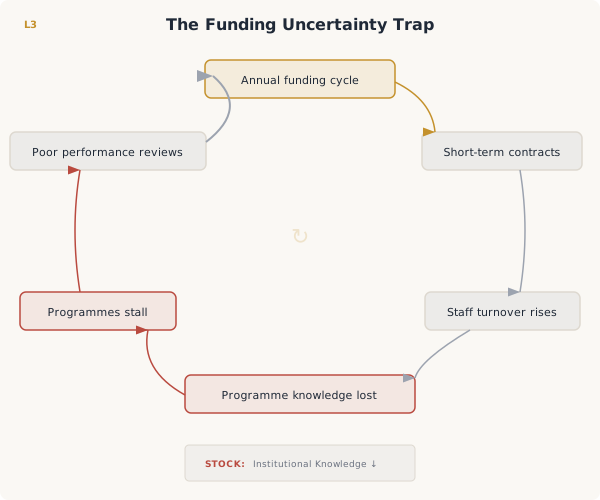
Why is annual funding fatal for multi-year programmes? Funding letters for Digital Health and Care Wales (DHCW) were not confirmed until 25% through the financial year (July 2022 is documented). Short-term contracts follow; staff turnover follows; recruitment costs absorb projected savings; planning collapses to weekly horizons. Multi-year programmes become structurally impossible — not because they are mis-designed, but because the funding signal arrives too late for the delivery system to act on it.
Welsh Government funds DHCW on annual budget cycles. Annual funding drives short-term contracts. Short-term contracts drive staff turnover. Turnover destroys programme knowledge that takes years to rebuild.
What is the Funding Uncertainty Trap at DHCW?
When knowledge walks out the door, programmes stall. Stalled programmes produce poor performance reviews. Poor performance makes multi-year funding commitments politically risky. So funding stays annual.
The loop is self-sustaining: annual funding produces the exact failure signal that makes multi-year funding look irresponsible, which keeps funding annual.
How It Manifests at DHCW
Annual funding is a real constraint; at DHCW it is mostly an alibi. Years of non-delivery cost the organisation its funder’s trust, and Welsh Government did what funders do when they stop believing the reports — it tried to force delivery by tying money to outcomes, and pressed DHCW on its own optimistic ratings. As the strategy director recounted: “the government was asking… why then are those programs rated red amber? If you’ve got a reasonable confidence that you will hold the implementation timetable, why are you reporting a low confidence?” WG cut the discretionary fund, withheld 30% in a quarter, and refused capital for e-referrals and the integration hub while still demanding the milestones. The board’s chair could not even follow the mechanism — “I find it a very strange way… if the 30% doesn’t arrive, then it tips us into deficit” — and an independent member called the model “antithetical to us being able to deliver effective investment… the longer you take to deliver a service, the more it costs.”
But the honest version cuts inward too. The transformation fund had been hollowed out from within: “DPIF has expanded to fit things that are arguably not that transformational… maintenance replay replacement or technology refresh.” The books would not close — by March 2026 the finance director read out an Accountable Officer letter recording that “the achievement of the remit in full is not possible without confirmed DPIF funding.” And five years in, the interim chair refused the excuse to its face: “if we’ve always struggled because it’s one-year funding… we should have worked it out by now surely.”
That is the trap shutting on itself — short money, lost knowledge, stalled programmes, annual settlements. None of it excuses the organisation. Denmark and Estonia run national health systems on much the same yearly cycles and deliver anyway. The cycle is a handicap; it is not why DHCW is worst-in-class. (Use with care: an independent member also noted DHCW “deliver[s] things with thin air” that then go “not monitored, measured” — evidence the constraint did not stop all delivery, only made it invisible. That is an accountability failure, not proof the money was the cause.)
What would a healthy alternative look like?
Multi-year funding is tied to specific programmes with externally verified milestones — not to the organisation. Programme continuity survives leadership changes. Staff are retained on permanent contracts because the funding horizon allows it. Institutional knowledge accumulates instead of draining.
How does the blueprint break the Funding Uncertainty Trap?
The structural fix is Break the Annual Trap: multi-year funding envelopes tied to programmes and verified milestones, not to the organisation. This severs the mechanism that makes short-term contracts rational in the first place. Knowledge retention stops requiring heroism from individual programme leads and starts being a property of the funding design.