The Credibility Death Spiral
Trust destroyed in days. Rebuilt over years. If you deliver.
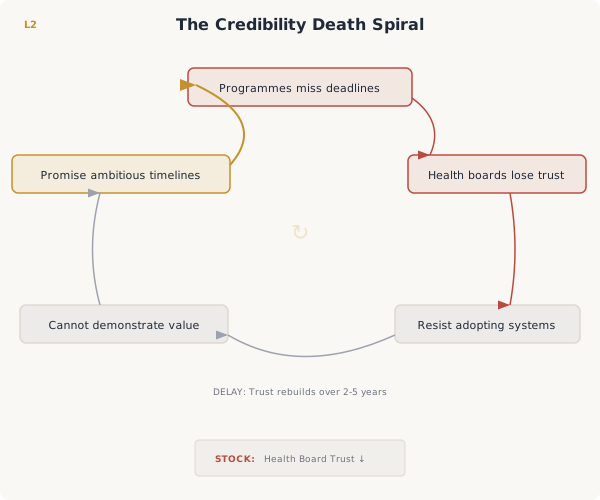
Trust between Digital Health and Care Wales (DHCW) and the seven NHS Wales health boards collapsed faster than it could be rebuilt. Every missed deadline destroyed credibility instantly; rebuilding requires two to five years of consistent delivery, which the structure cannot sustain because the depletion of trust accelerates the next failure. The result is a death spiral: lower trust drives lower clinical engagement, drives weaker requirements, drives worse delivery, drives still lower trust.
Programmes miss deadlines. Health boards lose trust. They resist adopting DHCW systems. Low adoption means DHCW cannot demonstrate value. The programme looks like a failure, attracting more scrutiny. Under pressure, DHCW promises ambitious timelines to show progress. It misses those too.
What is the Credibility Death Spiral at DHCW?
Trust is destroyed in a single missed deadline. Rebuilding it takes 2-5 years of consistent delivery. One cycle of over-promising and under-delivering can take half a decade to recover from – even if delivery improves immediately.
The asymmetry between how quickly trust is destroyed and how slowly it is rebuilt is the core of the loop: every broken promise compounds the next.
How It Manifests at DHCW
At DHCW the problem was never only missed deadlines — it was that nobody inside could say which deadline was about to be missed. The strategy director admitted it flat: “We currently don’t track any kind of measurement of confidence in delivering every milestone… We don’t do that.” His own illustration: “the biggest disappointment for me was when we met in June and asked, Are we on track for these milestones?… The answer was, Well, yes, we are, because nobody had informed that they thought they were going to slip. But two, three weeks later… around 30 of those milestones really had slipped.” By the next quarter the deputy chief executive had to take the reading live in the room — “I’ve just tapped Lindsay on the shoulder from our performance team to just see where we are. And currently we’ve done 45” of 107 — because the number wasn’t to hand. When the reporting is that hollow, every green light is worthless.
And the customers have stopped believing all of them. The community-care system built to run once for all of Wales is eleven years and over £42M in, with two local authorities now actively seeking to exit, on the Auditor General’s own account. The flagship patient app drew the NHS Wales deputy chief executive’s verdict in open session: “there’s hardly anybody in the population who are registered and are using the app regularly” — he compared it to an earlier system that “fell flat and nobody used it” — against 653,000 waiting-list patients it cannot touch. Eye care is more than four years late and live in two boards of seven; “all bar two of the health boards have released their staff” from the programme for want of funding. The national data platform — restated to £73.6M — drew its own director’s epitaph: “we’ve built a really fantastic… platform. But until there’s data in it, we can’t use it for much.”
That is the spiral, undisguised. Under a once-for-Wales monopoly the boards cannot take their custom elsewhere, so their distrust never forces a fix. It just sets — into the flat expectation that nothing promised will arrive.
What would a healthy alternative look like?
Governance requires conservative timelines validated by independent technical assessment before commitments are made to Senedd or health boards. Delivery is demonstrated before the next promise. When a deadline is missed, the post-mortem is published. Trust recovers naturally because stakeholders see honesty, not theatre.
How does the blueprint break the Credibility Death Spiral?
Rebuilding trust requires changing what goes out the door. Radical Transparency closes the gap between internal narrative and external reality — if health boards can see delivery data directly, the theatre stops working and the asymmetry between promise and outcome becomes visible in real time. Flip the Model creates the underlying delivery capability, so that the commitments made under transparency can actually be met. Transparency without delivery accelerates the spiral; transparency with delivery reverses it.