Captured Governance
They don't just hide from the searchlight. They disable it.
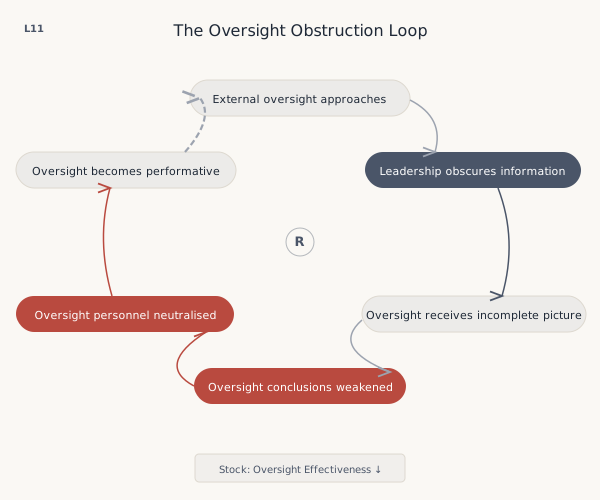
What is captured governance at Digital Health and Care Wales (DHCW)? It is the active degradation of oversight — not hiding from scrutiny, but disabling it. Eighteen consecutive months of zero corrective actions from the Performance and Delivery Committee. Audit Wales declared 'good governance, stable and cohesive board' four months before Level 3 escalation. The independent digital expert appointed under the Level 3 framework has never been publicly identified. Twelve months of Level 3 produced no de-escalation and no consequences; in April 2026 DHCW was escalated further to Level 4 Targeted Intervention.
Suppressing internal feedback is one thing. Blocking external information is another. L11 is something else entirely: actively degrading the oversight function itself.
What is captured governance at DHCW?
Oversight obstruction differs from information suppression in kind, not degree. Suppression hides the searchlight’s view. Obstruction disables the searchlight. Once an oversight role is hollowed out, the capacity does not regenerate: the institutional knowledge walks out with the person, and the replacement — if there is one — inherits a capture-ready role rather than a functioning one.
The delay is permanent. What is removed does not come back on its own.
How It Manifests at DHCW
The machinery built to catch a failing organisation certified a healthy one. Four months before enhanced monitoring, Audit Wales found “DHCW’s corporate arrangements support good governance” and “a stable and cohesive board that conducts its business appropriately, effectively, and transparently.” The monitoring that followed ran a full year without effect; in April 2026 DHCW was pushed to Level 4, “with concerns around delivery, accountability and leadership.” Oversight that runs a year without consequence, on a body its auditor had just blessed, is not oversight. And the assurance machine kept certifying health to the end: internal audit issued “reasonable assurance” the day before the Level 4 escalation — and the one mechanism meant to stop unsound programmes being funded, the Strategic Investment Panel, had been quietly “stood down” in 2024-25.
The capture is visible at every scale. The board secretary explained the organisation’s habit of over-promising as a virtue — “we are very keen to please… but sometimes that doesn’t give us the buffer if something goes wrong.” Conflicts of interest were treated as a formality, the register carrying “nil” returns against interests that were, in fact, held. When criticism finally came in writing, it was managed down: the Director General put seven concerns to DHCW — among them that “risks and failure to deliver milestones are not being reported and escalation to WG in a timely and transparent manner” — and the public summary reduced all seven to two words: “too transactional.” Nor could the system examine itself: the 2024 NHS Wales accountability review, which gathered evidence of “a culture of reactive blame… a reluctance to seek external intervention, resulting in crisis management becoming the norm,” was chaired by the former NHS Wales Director-General who had presided over the governance architecture being reviewed and now chairs a body operating inside it.
And beneath the procedure sits a warning no one wanted recorded. Of the portfolio’s £200M-plus, a Welsh Government finance official told a public meeting that with delay “the benefits might be zero by the end. If we’d have known that, we’d have never started” — then asked DHCW how it would stop that happening again. That is the real state of the thing the governance existed to assure — said aloud, in passing, by one of the people meant to be assuring it.
What would a healthy alternative look like?
Oversight bodies have independent, unfiltered access to delivery data — not mediated through the people being overseen. Technical oversight roles are structurally protected: departure of the person fulfilling that role triggers automatic replacement, not a gap. Monitoring frameworks have teeth — escalation produces consequences on a defined timeline, not open-ended observation. When governance is not captured, the oversight function cannot be degraded from inside.
How does the blueprint break captured governance?
Obstruction of oversight cannot be remedied from within the obstructing organisation. Breaking L11 requires two moves together: Competent Leadership replaces the leadership actively degrading the oversight function, and the governance redesign distributes oversight across multiple actors with overlapping jurisdiction — so that capture of any single channel does not neutralise accountability entirely.