The Information Fortress
Every door barred. Every question refused.
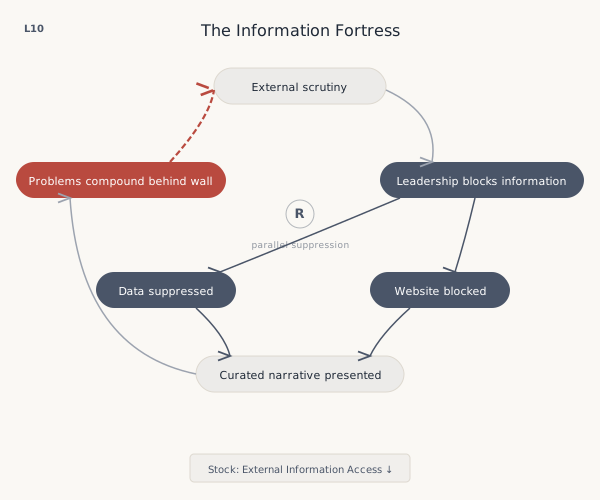
How does Digital Health and Care Wales (DHCW) control what leaves the building? Its own record shows the pattern: a whistleblowing-triggered Limited Assurance recruitment audit has not been published, the 2024–25 Duty of Quality reports 'remain unapproved and unpublished', and the substance of governance sits in 'PRIVATE Abridged' minutes. Zero accountability data is published — no whistleblowing statistics, no disciplinary outcomes, no contract values, no programme-level delivery data. Multiple FOI requests have been refused on grounds that do not survive scrutiny. The information apparatus is one-way: outbound communications are produced; inbound scrutiny is intercepted before it can reach the people inside the building who could act on it.
Every door barred. The information fortress is not a single wall but a system of interlocking barriers.
What is the Information Fortress at DHCW?
An information fortress buys time. Data that would contradict leadership’s narrative is withheld, unpublished, or released in formats designed to resist scrutiny. For 6-18 months, the barrier works. But when reality breaks through — escalation, campaign pressure, a public failure — the gap between what was reported and what is real creates a crisis of confidence far worse than continuous transparency would have produced.
The cover-up becomes the scandal.
How It Manifests at DHCW
Begin with what cannot be found. DHCW publishes no whistleblowing figures, no disciplinary outcomes, no account of who leaves or why; the value of its largest-ever contract was never stated in the public forum that approved it (the governance record). At this scale of public spending, the gaps are policy, not oversight.
What is published is worse, because it looks complete. The minutes are a fraction of the meetings — the sanitisation record at L6 counts the instances, and the worst case predates Co-pilot by eighteen months, so the tool is the accelerant, not the cause. The cutting reaches the statutory documents: in the annual report the reason for the Welsh Government’s escalation reads “…including:” — and then nothing. And the laundering is sometimes active: at one board the chair told the public session there were no declarations of interest, the public minutes recorded none — while the private minutes noted an independent member “may have had a declaration relating to item 2.2 WICIS,” raised only after the cameras stopped.
The result is a body its own overseers cannot see into. The chair conceded to Welsh Government that DHCW gets “informed in what we perceive to be late in the day”; the Cabinet Secretary named “the pattern of late notification that undermines system confidence and disrupts operational planning across Wales.” That is the fortress — less a wall around the building than a fog inside it, thick enough that even the people paid to watch are told only what suits, and only when.
What would a healthy alternative look like?
Accountability data is published proactively on a statutory schedule — whistleblowing reports, disciplinary statistics, staff turnover analysis, contract values, programme delivery status. FOI requests are assessed on merit. Board papers are published in searchable, accessible formats. No public information source is blocked on internal networks. Transparency is the default, not a concession.
How does the blueprint break the Information Fortress?
The fortress only stands because its custodians control what leaves the building. Radical Transparency strips that discretion: statutory publication cadence for whistleblowing, disciplinary, leaver, contract, and delivery data; searchable board papers; no more unexplained blocks on public information sources. When publication is mandated rather than permitted, the fortress ceases to be a viable strategy.