The Hiring Trap
More people hired. Less delivered. Every year.
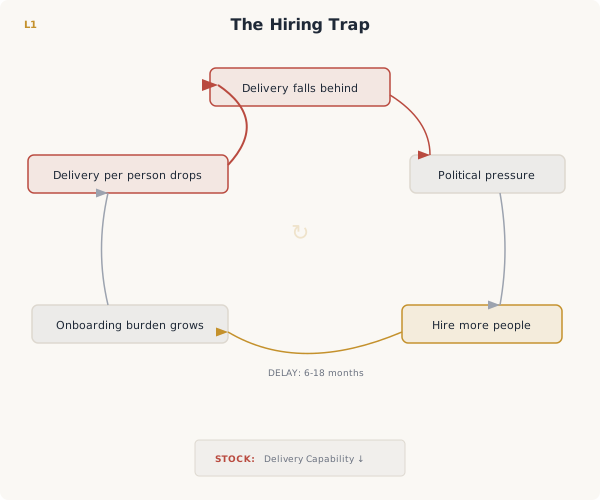
What is the hiring trap at Digital Health and Care Wales (DHCW)? Headcount grew 87% — from 675 to 1,263 staff — while delivery worsened. Brooks's Law operated at organisational scale: each new cohort imposed onboarding burden on the productive staff already overstretched, and coordination overhead grew faster than output. The headline flow (recruitment) looked healthy; the underlying stock (delivery capability) was draining.
When delivery falls behind, the instinctive response is to hire. DHCW grew from 675 to roughly 1,263 staff – an increase of 87%, with 22.6% growth in the last year alone.
What is the Hiring Trap at DHCW?
Brooks’s Law, documented in 1975, explains why adding people to a late programme makes it later. Each new hire pulls experienced staff away from delivery and into onboarding and coordination. Communication overhead grows with the square of team size. In a specialised domain, new hires take 6-18 months to become productive.
The headcount appears on the dashboard immediately. The productivity does not.
Delivery capability drops despite more people. Political pressure intensifies. The response: hire even more.
How It Manifests at DHCW
At DHCW the trap runs deeper than Brooks’s Law. Headcount has gone from 675 to about 1,263 — up 87%, a fifth of it in the last year — and the organisation has never delivered less. Its own Executive Medical Director said the quiet part at a public board: “I don’t really want to sound controversial, but I’m gonna raise the productivity paradox across the NHS. You know more people, but we are not delivering perhaps what we were delivering pre-COVID.” That is a clinician, not a campaigner, naming the thing the money was supposed to disprove. Against £600M, the entire quantified return is about £0.5M of non-monetary time-saving — eighty pence for every thousand pounds — and not one patient outcome anyone can name; asked to show the value, the chief executive could say only that “it would be lovely to sit here and be able to demonstrate the value.”
The cost to the workforce was foreseen and waved through — twice. Audit Wales had warned that “risks around staff vacancies need to be well managed to ensure that this does not negatively impact the well-being of existing staff.” And at the 29 September 2022 board, the Chair, Simon Jones, warned in plain terms: “making recurrent savings through non-recurrent vacancies… is something I’ve got the scars on my back about… you just heap misery on misery every year when you do that.” The warning was completely erased from the published minutes. The strategy continued: by Q1 of Year 4, 84% of the in-year savings target had been delivered through unfilled posts. Sickness is up 82% in three years (8,684 days lost to 15,846), long-term sickness up 59%, with stress and anxiety the largest cause of lost days in DHCW’s own annual report — and more than half the workforce recording absence. Two-thirds reported burnout; a year after the wellbeing push the People director confirmed it had not turned: “it’s increased by 3.9% since last year” — a figure then stripped from the published minutes. The remedies were threadbare and the executives knew it: the finance and operations director admitted, of getting staff to stop work at contractual hours, “we haven’t cracked this one if I’m honest.” Internal audit was blunter still, finding the wellbeing initiatives “reactive, with some limited evaluation of their effectiveness or cost benefit impact.” A wellbeing portal was the answer to a wound the organisation keeps inflicting — almost to the letter, the inverse of the conditions under which technology gets built.
So the headcount measures nothing. It rises, delivery doesn’t, and the people under it are used up — which is also why the work keeps getting handed to vendors who leave no capability behind. (Anticipated rebuttal: DHCW will cite a sector-wide engagement dip — “all but two organisations across NHS Wales” fell. True, and not the point: the sector did not double its headcount to no measurable delivery, nor engineer vacancy savings as its primary financial instrument.)
What would a healthy alternative look like?
Governance tracks delivery per person, not headcount. Hiring targets specific skill gaps identified by independent audit. New hires are measured against delivery contribution within 12 months. If output per person declines despite growth, the hiring strategy is revised — not doubled down on.
How does the blueprint break the Hiring Trap?
Breaking the hiring trap requires two interventions acting together. Portfolio Ruthlessness stops the demand spiral: fewer programmes mean headcount can be matched to work the organisation can realistically deliver, rather than scaled to mask political pressure. Flip the Model changes what hiring is for: internal capability build, not vendor coordination overhead. Together they convert headcount from a political signal back into a delivery input.