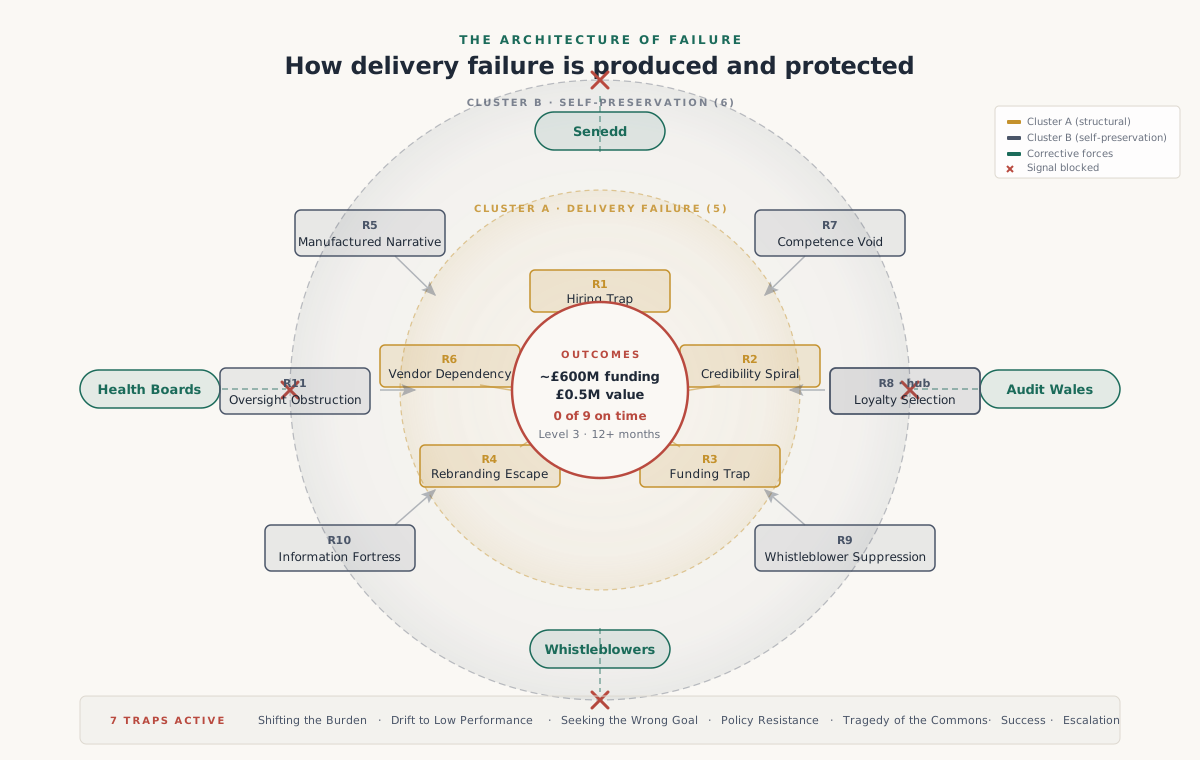
Eleven feedback loops, two clusters, one architecture. The five loops of Cluster A produce the delivery failure. The six loops of Cluster B make sure it is never fixed — they intercept every corrective mechanism the system was given before it can reach the first five. The diagram below shows how the two clusters lock together.
The Missing Thermostat
Every complex organisation needs a balancing loop — a corrective cycle, like a thermostat, that detects problems and triggers reform. In a healthy system, the cycle works like this: delivery failures are visible, oversight bodies investigate, accountability is enforced, leadership changes or adapts, structural conditions improve, and delivery recovers.
Digital Health and Care Wales (DHCW) has this mechanism. It is called Level 3 — the formal “enhanced monitoring” tier of the Welsh Government 5-level NHS escalation framework. DHCW sat at Level 3 for more than twelve months with no de-escalation, and changed nothing: no leadership change, no structural reform. In April 2026 it was escalated again, to Level 4 Targeted Intervention. That has not corrected the failure either. The Cabinet Secretary’s own verdict on the framework meant to force the correction — “complex, data-heavy, burdensome, lacks transparency and does not drive improvement” — describes a thermostat that has been captured at every level it defines. The mechanism did not fail to fire. It was disabled.
This is the central finding: DHCW does not lack corrective mechanisms. Cluster B has neutralised every one of them. And it did not erode gradually — every governance-deficit pattern visible at Level 3, almost four years in, was already running at the very first board meeting. The architecture was complete on day one. The NWIS continuity documented at Why this Blueprint, section 1 explains why: the same leadership cohort, the same patronage pipeline, the same culture imported wholesale into a rebranded body. Day-one completeness is not coincidence. It is inheritance.
The operational signature is a repeating one: near-identical infrastructure failures, twelve months apart, with nothing fixed in between — the data-centre timeline is the clearest exhibit, and the loops below document the same signature everywhere else.
How the Corrective Pathways Are Blocked
Six specific mechanisms intercept every corrective pathway before it can reach the delivery failures in Cluster A.
- L6: Manufactured Narrative — internal perception is managed. Staff satisfaction surveys reported 80% approval while the organisation sat under Level 3 escalation.
- L7: Competence Void — the people who could diagnose the problem are overridden, sidelined, or leave.
- L8: Loyalty Selection — the people who replace them are selected for loyalty, not competence.
- L9: Whistleblower Suppression — internal signals of failure are suppressed. Those who raise concerns are managed out rather than heard.
- L10: Information Fortress — external signals are blocked. The public-facing website is inaccessible. Zero accountability data is published.
- L11: Oversight Obstruction — the external oversight function itself is actively degraded from inside the organisation.
Every corrective signal — from a clinician, a health board, an auditor, a Senedd committee — hits at least one of these six loops. Most hit several. None reaches Cluster A intact. That is not friction. It is design.
Cluster B is operationally possible because the cultural prerequisite for surfacing bad news has been inverted. The delivery research is settled: psychological safety is the condition under which staff can raise concerns, challenge senior decisions, and admit uncertainty without career penalty. DHCW’s culture is documented as the structural inverse. L6 manufactures narrative because staff fear what happens when they don’t agree with it. L9 punishes whistleblowers, which teaches the rest of the workforce not to be one. L10 blocks external information, which prevents staff from corroborating their own perceptions. The six loops are not six independent mechanisms; they are six expressions of one absent cultural prerequisite.
The structural container in which Cluster B operates is the “once for Wales” monopoly delivery model — reframed in software-engineering terms as an antipattern, a popular structural choice that looks like the obvious answer but reliably produces the failure modes it was meant to prevent. No exit option for health boards; no external benchmark for quality; standards and delivery inseparably coupled. Every loop documented below operates inside that container, which is why none of them have been displaced by reform aimed at any single loop.
Why No Single Fix Works
A reform aimed at any single loop is absorbed by the others. Fire the CEO? L8 selects the next one for loyalty. Demand transparency? L10 releases aggregated numbers that manufacture the opposite narrative. Protect whistleblowers on paper? L9 redefines the complaint as a conduct issue. Commission an external review? L11 controls the terms of reference.
This is why headcount grew 87%, spend reached £600M, Level 3 Enhanced Monitoring passed its first anniversary, and DHCW was escalated to Level 4 in April 2026 — and the underlying failure remains intact. The interventions targeted Cluster A symptoms while Cluster B remained untouched. The architecture absorbed each attempted correction and returned to its prior state.
What the Diagnosis Is Built On
The eleven feedback loops are derived from a systematic analysis of DHCW’s institutional processes and public record — five years of board and committee minutes (April 2021 – March 2026), Welsh Government performance-escalation correspondence, Audit Wales structured assessments, and FOI disclosures — combined with the author’s lived experience as the organisation’s most senior technical leader short of executive level.
The structural finding repeats across the timeline. Declarations of interest were treated as a formality from the start — the register carried “nil” returns while interests were, in fact, held — and the executive cohort itself was assembled through a long-running patronage pipeline that has drawn three successive NHS Wales chief executives from a single health board. Non-declaration was not a deterioration from some healthier earlier state. It was the default configuration from day one.
By count: 51 instances of board approval without scrutiny, 45 instances of undeclared interests at specific meetings, 63 instances of failure to act on a flagged risk — and the sanitisation record on top.
Why the Blueprint Is Sequenced the Way It Is
The blueprint treats Cluster B as the prerequisite, not the follow-up. Intervention 1: Competent Leadership removes the people currently operating Cluster B — forensic review, mandated data publication, protected reporting channel, leadership change where the evidence demands it. Only then can Interventions 2-5 address Cluster A. Any other sequence is absorbed.
This is the analytical claim that makes the Digital Blueprint for NHS Wales different from the dozens of prior reform attempts: the structural problem and the self-preservation engine that guards it are both present, and you have to dismantle the second before you can fix the first.
The system is not failing despite leadership’s efforts. It is succeeding at the wrong goal.