Reform that breaks a live clinical system discredits itself in a day. The transition plan's first rule is therefore boring on purpose: every live service keeps running, with a named owner, through every organisational change. The strangler-fig pattern the architecture uses for systems applies to the organisation itself — the new grows around the old, takes load gradually, and the old is retired one boundary at a time. Never big-bang.
The four workstreams
1. Services — the continuity register. Day one: a register of every national service in clinical use, each with a named accountable owner, a runbook, and a designated destination (standards body / health board / retire). No service changes hands without its runbook and a shadow-running period. The register is public; the live status page reports against it. The PSBA and data-centre record is the reminder of what “we’ll sort ownership later” costs.
2. People. The destination map is in the operating model: ~400 to the standards body, embedded teams to boards, honest treatment of roles that end with the monopoly. Mechanics: protected transfers under the staff-transfer rules that govern NHS Wales reorganisations, a retraining fund inside the £5–15M transition budget, transfer sequencing tied to service moves (people move with their service, never ahead of it), and a no-detriment rule for the transition period. Publish the map early: uncertainty, not change, is what empties an organisation of its best people — the record on that is unambiguous.
3. Contracts — the £1.25B portfolio. Every contract above £100K is audited and assigned one of four dispositions, published on the transparency dashboard:
- Keep-national (backbone, infrastructure, terminology): novate to the standards body.
- Transfer-to-board (clinical applications): novate to the procuring board with knowledge transfer written into the novation.
- Re-tender: sole-bidder contracts above £1M without a published justification — per Flip the Model.
- Terminate/expire: contracts serving programmes on the stop list; exit costs stated, not hidden.
The contract audit includes legal review of novation clauses — any contract with change-of-control penalties is flagged before sequencing decisions are made, not discovered after.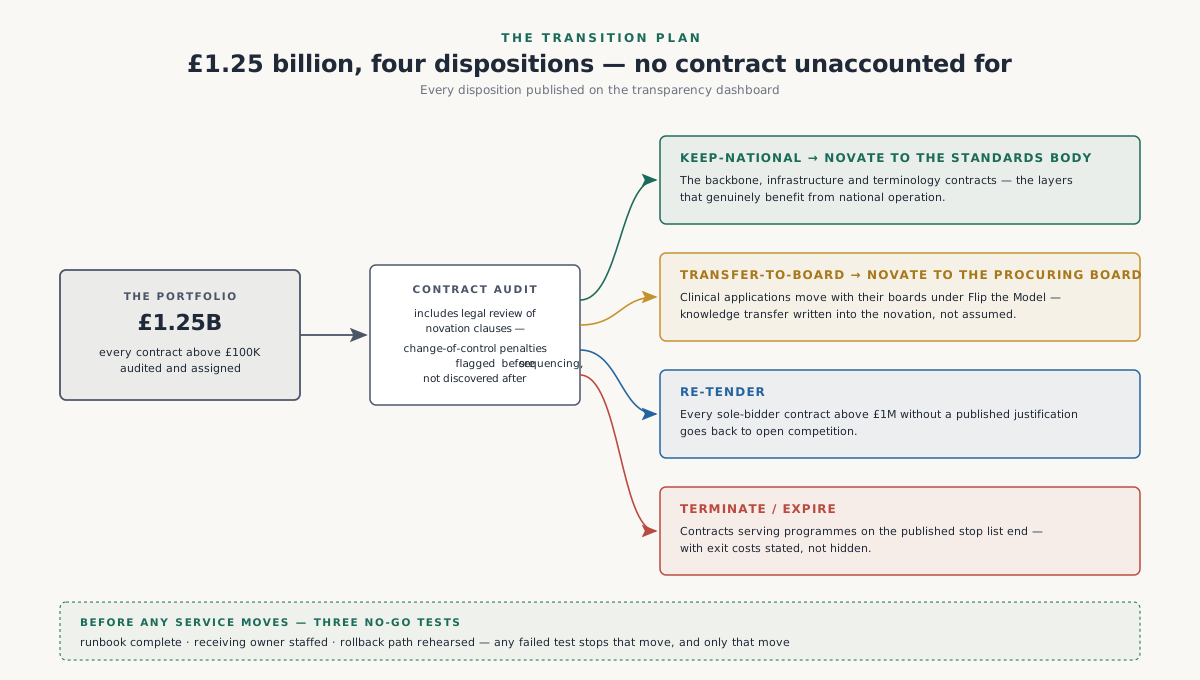
4. Money — dual-running, stated honestly. Transitions cost twice for a while: the old estate runs while the new stands up. The transition budget carries an explicit dual-running line rather than pretending the overlap away — the pretence is how transitions get quietly abandoned at month nine. The offsetting savings start immediately from the stop list and the re-tendered contracts; the economics already net this off.
Sequencing and the no-go conditions
The workstreams hang off the 36-month timeline: continuity register and contract audit in months 0–6; first service and people moves only after month 6, gated on the leadership reset — transferring services into an unreformed governance is the one way to make things worse. Three no-go tests before any service moves: runbook complete, receiving owner staffed, rollback path rehearsed. Any failed test stops that move and only that move — local failure, by design, exactly as the architecture promises for systems.