The target architecture needs an organisation to run it. This page designs that organisation: a standards-and-interoperability body of roughly 400 people at steady state — scaled from Estonia's TEHIK, which runs the equivalent function for 1.3 million people with 200 — and a clear destination for every one of the 1,263 current staff of Digital Health and Care Wales (DHCW). The successor is not a smaller DHCW. It is a different kind of body, doing a smaller set of things completely.
What the body does — and does not do
The standards body owns layers 2–4 of the target architecture: identity and audit, the interoperability backbone, and the thin set of national shared services. It certifies; it does not build clinical applications. Health boards own layer 5. Citizens own consent and access at layer 6.
Six functions. Nothing else.
- Standards and conformance. Publishes the national data and interoperability standards. Runs the automated conformance suites that gate health-board procurement. Publishes every pass and fail.
- Platform operations. Operates the interoperability backbone, the terminology services, the national identity services, and the audit ledger — as products, with published SLOs and a live status page.
- National shared services. The demographics service, the practitioner index, the prescription and referral gateways, the federated Welsh care record. Building blocks, each with a typed API. None holds the clinical record.
- Cyber defence. The national security operations centre for shared infrastructure, operationally separate from delivery.
- Architecture and assurance. A small team that maintains the target architecture, reviews exceptions, and runs genuine post-mortems — published within 14 days.
- Enablement. Supports health-board digital teams with shared tooling, golden-path templates, and the delivery standard. Advises; never mandates a product choice.
The shape
Roughly 400 people at steady state. The split below is the design’s starting point — refined against the published service catalogue, not against last year’s org chart:
| Function | ~Headcount | Note |
|---|---|---|
| Platform engineering & operations | 140 | Backbone, identity, audit, terminology — run as products |
| National shared services | 90 | Demographics, prescriptions, referrals, care record |
| Standards & conformance | 45 | Includes the public conformance-test suites |
| Cyber defence | 50 | 24/7 SOC for shared infrastructure |
| Architecture & assurance | 25 | Includes post-mortem facilitation |
| Clinical informatics | 20 | See Clinical Leadership and Safety |
| Corporate (finance, people, legal, comms) | 30 | Thin by design |
Three structural rules keep it honest. Every function has a published service catalogue and unit cost. Corporate services never exceed 10% of headcount. And the body has no programme-delivery directorate — the moment it acquires one, the monopoly is rebuilding itself.
Leadership
The executive team is small — CEO, CTO, CISO, Chief Clinical Informatics Officer, Director of Standards, COO — recruited externally against published technical criteria at market rates, by an external panel, exactly as Intervention 1 specifies for the transition and the comparators practise as routine. The board includes technical NEDs and a citizen member nominated by the patient council (Citizens).
Where 1,263 people go
The politically decisive question, answered directly. The current headcount maps to four destinations: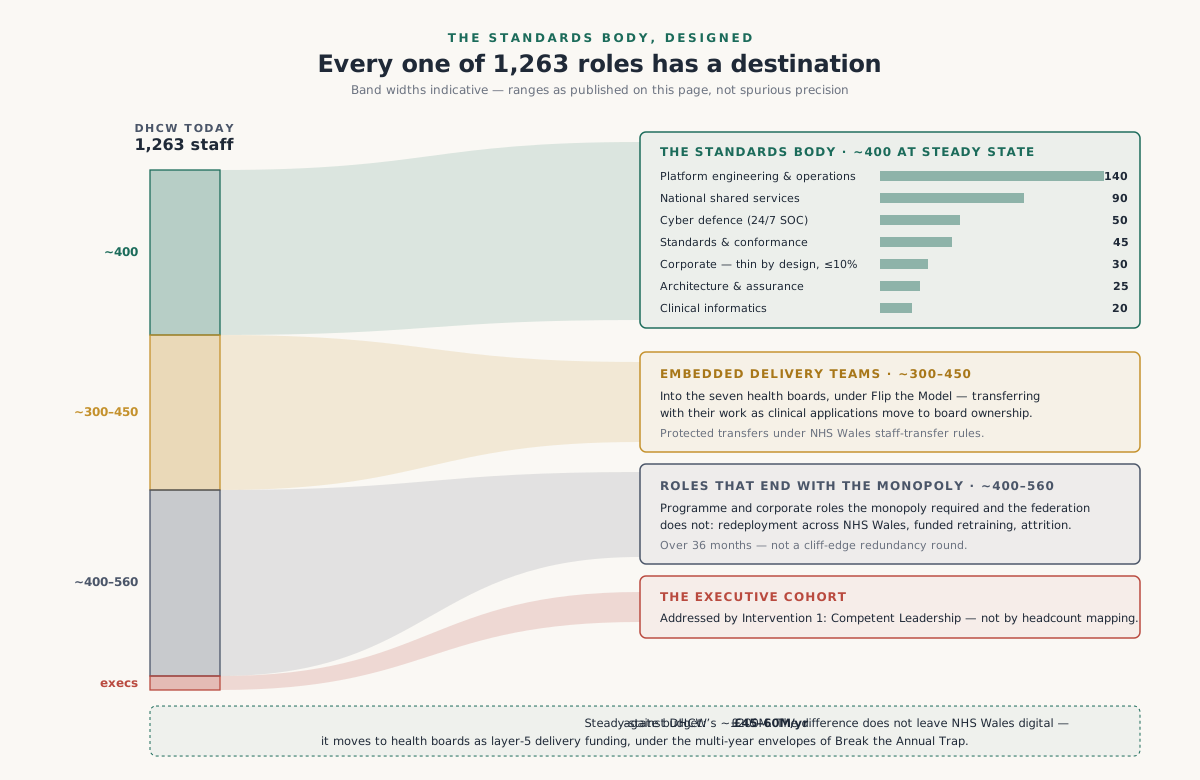
- ~400 → the standards body, by matching to the functions above. Platform, security, terminology, demographics and integration engineers largely map across.
- ~300–450 → embedded delivery teams in health boards, under Flip the Model, transferring with their work as clinical applications move to board ownership. Employment transfers are protected transfers under the staff-transfer rules that govern NHS Wales reorganisations.
- The remainder → programme and corporate roles that end with the monopoly. Handled honestly: redeployment support across NHS Wales, retraining funded from the transition budget, and natural attrition over the 36 months — not a cliff-edge redundancy round. The transition plan carries the detail: The Transition Plan.
- The executive cohort is addressed by Intervention 1, not by this page.
The economics already include this people plan. What it buys is an organisation one-third the size doing a job that is finally finishable.
The budget
The standards body runs on £45–60M a year at steady state — platform operations, shared services, cyber, and staff — against DHCW’s ~£200M. The difference does not disappear from NHS Wales digital: it moves to health boards as delivery funding for layer 5, where the clinical value is created, under the multi-year programme envelopes of Break the Annual Trap.
Every element of this operating model runs today somewhere in northern Europe. The design decision Wales has to make is not whether it works. It is whether to build it.