Reform at Digital Health and Care Wales (DHCW) is tracked across four quadrants, monthly:
- Features shipped per programme per month
- Adoption: % target users actively using weekly
- Health board sentiment survey (quantified)
- Clinician-initiated requests per month
- Published data completeness
- Whistleblowing/disciplinary data published
- Digital-system-linked incidents reported
- Royal College assessments
Baselines and targets
Reform without numbers is a mood. Each headline indicator starts from today’s documented baseline (sources at the facts page); the 12- and 36-month targets are what the Digital Blueprint for NHS Wales proposes, to be ratified by the incoming board — and once ratified, published and unmovable.
| Indicator | Baseline (today) | 12-month target | 36-month target |
|---|---|---|---|
| Staff burnout (survey) | 68.9% | Published unedited; falling | ≤ 40% |
| Working days lost to sickness | 15,846 / yr | Trajectory reversed | ≤ 10,000 / yr |
| Curation ratio of published minutes | 8.6–16% | ≥ 60% | Transcript-fidelity |
| Programmes delivering on time | 0 of 9 | 3 priority programmes on plan | Portfolio-wide, published per programme |
| Board-minute publication lag | Months, variable | ≤ 14 days | ≤ 14 days, statutory |
| Contracts >£100K published within 30 days | Not published | 100% | 100%, statutory |
| NHS Wales App | Registrations reported, use not | Weekly actives published | Weekly actives rising, task completion published |
| Health-board sentiment (“DHCW delivered what they promised”) | 13% positive | First board says yes | Majority of boards say yes |
Quarterly assessment: Has Cluster B been broken? Which Cluster A loop is currently strongest? Has L2: Credibility Spiral reversed? Are new loops emerging?
Red flags. Any of the following signals that the reform has been captured by the system it was designed to change:
- Dashboard launch delayed past month 9.
- “Context” columns added to soften delivery numbers.
- Embedded team leads hired from within DHCW.
- Multi-year funding allocated to the organisation rather than to programmes.
- Curation ratio of published board minutes drops below 60%.
- Any new “declared nil” entry against a director with a known undisclosed interest.
- “Receive and note” cadence above 50% of substantive board agenda items.
- Audit Wales positive assessment within six months of a worsening of measurable indicators (the captured-assurance pattern from 2025).
- Approval-without-scrutiny on any contract above £5M.
- Recruitment freezes paired with milestone tightening (the 2026 remit-letter pattern).
- Staff-welfare suppression — burnout figures absent from published staff-survey items; year-on-year change stripped; sickness trajectory not published alongside headcount; any action item recorded as “Received & Discussed. Action: None to note.” against a worsening staff-welfare indicator.
- Infrastructure-incident recurrence — any second occurrence of the same failure pattern within 18 months without a published corrective-action close-out (the data-centre pattern).
Reform-the-Funder leading indicators (Intervention 6): RAG-rating audit trail visible to the Senedd Public Accounts Committee monthly, with every rating change logged by author, date, and rationale. Capital-allocation timing relative to programme inception (capital settled before fiscal year start, not later). Remit-letter content scored against milestone load — any reduction in input authority paired with proportionate output relief. Frequency of Welsh Government named in published programme post-mortems alongside DHCW.
When an intervention appears not to be working, use this decision tree before concluding it has failed: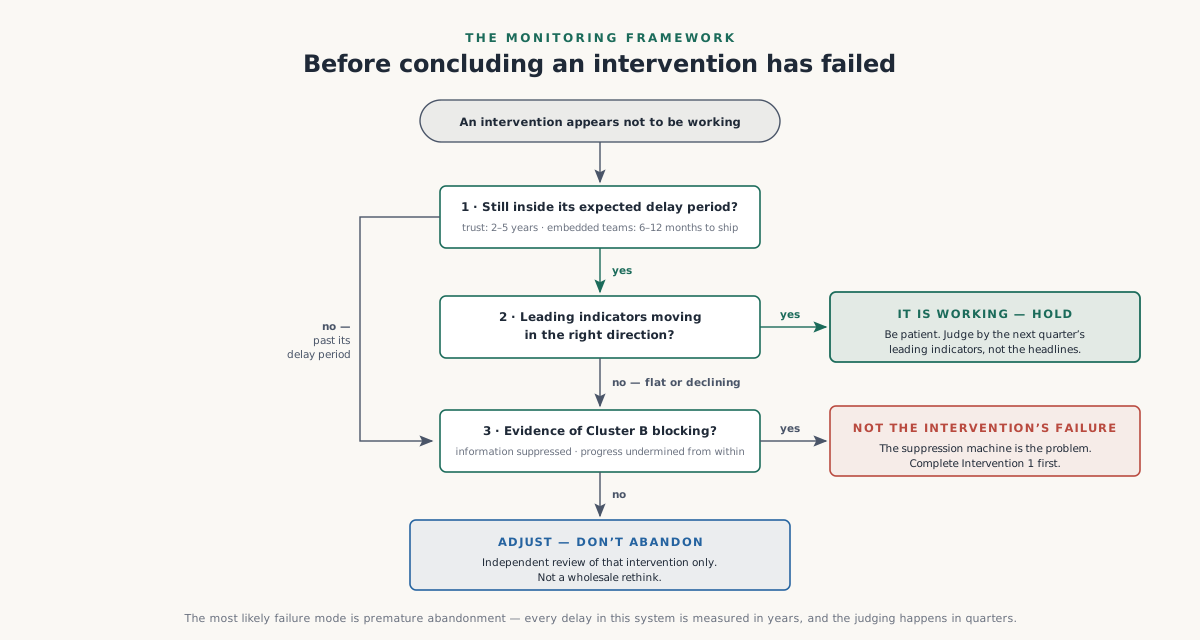
- Has the intervention been in place for less than its expected delay period? (Trust rebuilds on a 2-5 year lag; embedded teams need 6-12 months to ship.) If yes — check leading indicators. If leading indicators are moving in the right direction, the intervention is working. Be patient.
- Are leading indicators flat or declining? Check whether Cluster B is blocking — is information being suppressed about the intervention’s progress? Is the intervention being undermined from within? If yes — the problem is not the intervention. It is incomplete implementation of Intervention 1.
- Are leading indicators flat with no evidence of Cluster B blocking? The intervention may need adjustment. Commission an independent review of that specific intervention, not a wholesale rethink.
The most likely failure mode is premature abandonment: people judge the reform too early, see no results, and abandon it. Every delay in this system is measured in years, not quarters. The decision tree pre-empts this.
The critical signal: One health board saying “DHCW delivered what they promised.” That is the single most important indicator. Everything else is leading. That is the outcome.