There is a genuine contradiction at the heart of this blueprint. The analysis argues that Welsh Government oversight of Digital Health and Care Wales (DHCW) has been weak, intermittent, and partly captured. The interventions proposed above require competent oversight of the transition. If the oversight body itself is part of the problem, who oversees the reform?
The honest answer: no single actor can be fully trusted. Welsh Government cannot be the sole guardian, because Welsh Government materially contributed to the failure conditions — pressured RAG ratings, mid-cycle DPIF cuts, capital funding refusals while milestones were retained, programme compression, recruitment freezes via remit letter. The design must distribute oversight across multiple actors with overlapping jurisdiction so that capture of any one channel does not neutralise accountability entirely. And the design must include reform of the Welsh Government function itself, alongside DHCW reform, via Intervention 6: Reform the Funder.
Actors who can operate independently of Welsh Government executive capacity:
- Senedd Public Accounts Committee – can mandate hearings, require testimony, commission Audit Wales investigations. A credible oversight actor but a part-time one; realistic role is periodic political accountability, not day-to-day transition management.
- Audit Wales – has statutory powers to access documents and examine accounts. Would need to commission specialist digital expertise for technical delivery assessment, which is feasible but not its current capability.
- Statutory publication requirements – legislation requiring DHCW to publish specific data categories on a fixed schedule removes the need for ongoing enforcement. Non-compliance becomes a legal matter, not a governance negotiation. This is the highest-leverage structural mitigation because it operates automatically once enacted.
- Information Commissioner’s Office – has enforcement powers over FOI compliance. Repeated FOI obstruction (documented at L10: The Information Fortress) is appealable to the ICO; sustained non-compliance attracts enforcement notices.
The design principle: route oversight through multiple independent channels rather than a single supervisory body. More complex than routing everything through Welsh Government, but more robust against the specific failure mode this analysis has identified – capture of the accountability mechanism by the people it is meant to hold accountable.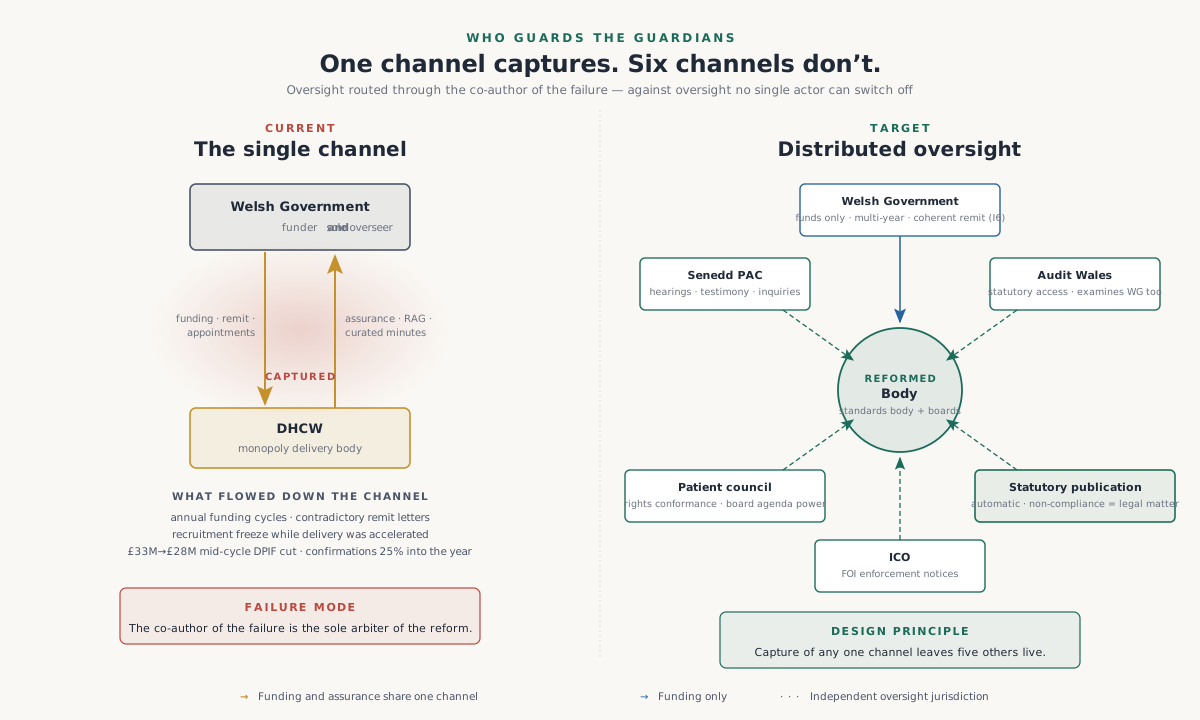
The Board That Replaces the Captured One
Distributed oversight at the regulatory level only matters if the board it oversees is structurally capable of receiving and acting on the signal. The record documents a board that approved without scrutiny on 51 occasions, with three sub-committees that produced zero corrective actions across eighteen consecutive months and were blind to imminent escalation. The two clearest procurement exhibits: the Chair of the Performance and Delivery Committee admitted approving a £20M Kainos framework without scrutiny — “I should have looked. I don’t know how these appear on our website as contracts” — and the £226M Microsoft Enterprise Agreement — the largest single thing DHCW buys — was handled at a ~13-minute extraordinary board where the chair stated the real decision was happening elsewhere: “We’re not going to formally approve it here today. We’re going to do that outside of this meeting.” The contract’s value was never stated in that forum at all — only a “£34.2M cost avoidance,” a discount measured against an option DHCW itself called impossible. Reform of the regulatory architecture above DHCW is necessary but not sufficient.
Intervention 1 accordingly includes a non-executive board reset: NED competence audit against published criteria; sub-committee reform with technical NEDs; structural protection of the kinds of governance challenge Rowan Gardner, Simon Jones, and Ruth Glazzard offered before they departed. Replacing the executive without reforming the non-executive cohort reproduces the same dynamic — a board that nods through what an executive presents.
The clearest evidence that the current board cannot self-reform sits in a single meeting — the Compassionate Leadership Pledge record. For the purposes of governance design it is one finding: the board that approved the Pledge cannot remediate the conditions it produced. The non-executive reset is structural, not optional.
The EPMA Gap
A second structural finding: DHCW is held accountable for milestones it does not control. EPMA is the clearest example — the national programme is a coordinating function, but local organisations are the accountable delivery body (Evans, on the record at PDC May 2025). DHCW is measured; the actors who can deliver are not. Welsh Government is the only body that can resolve this triangle, and the resolution belongs in Intervention 6: Reform the Funder rather than in distributed-oversight design — because no oversight architecture can correct accountability that has been written incoherently in the first place.