Architecture says what gets built; the delivery standard says how. Wales does not need to invent one. The Centre for Digital Public Services already publishes a Digital Service Standard for Wales, and the NHS service standard exists alongside it. The Digital Blueprint for NHS Wales adopts them, adds the health-specific discipline, and — the part that matters — attaches consequences.
The standard, in one screen
Every digital service built for NHS Wales, by the standards body or a health board team:
- Starts with users. Discovery before commitment. No business case without named clinicians and patients who have been observed doing the work the service touches.
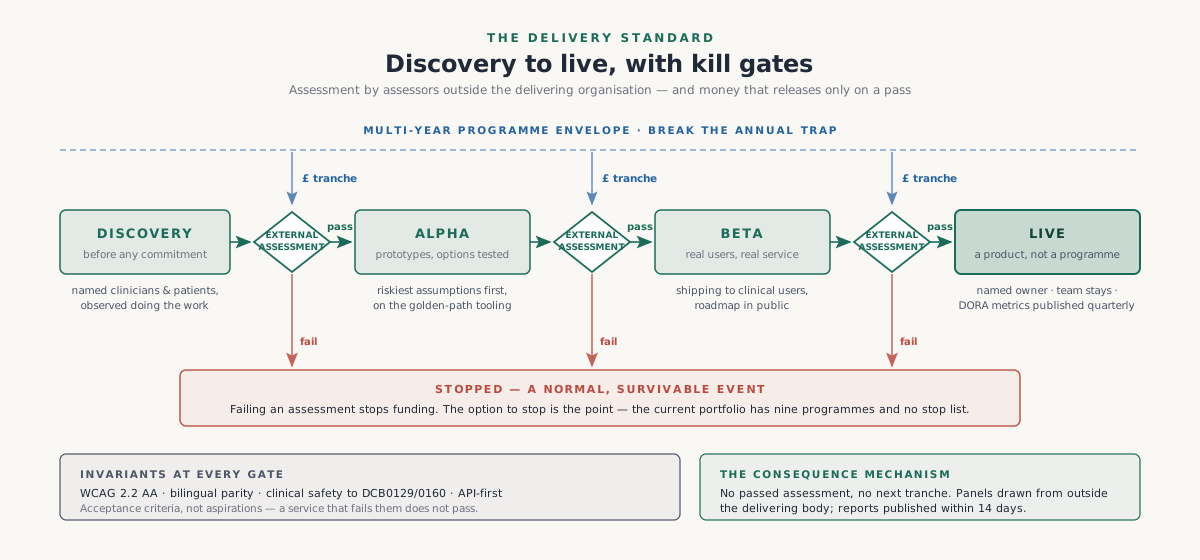
- Moves discovery → alpha → beta → live, with kill gates. Each phase ends in an assessment by assessors outside the delivering organisation. Failing an assessment stops funding. The option to stop is the point: the current portfolio has nine programmes and no stop list; the standard makes stopping a normal, survivable event.
- Ships as a product, not a programme. A named product owner with decision rights; a team that stays with the service in live; roadmaps in public. Programmes end; products are run.
- Publishes its delivery metrics. The four DORA measures — deployment frequency, lead time, change-failure rate, time to restore — published per team, per quarter, on the national dashboard. Not as surveillance: as the profession’s own scoreboard. Teams that ship weekly have nothing to fear from a chart.
- Builds on the golden path. The standards body maintains platform tooling — pipelines, environments, observability, security scanning — so a new team ships its first change in days. Divergence is allowed and documented, never accidental.
- Meets the invariants. WCAG 2.2 AA accessibility, bilingual parity per the citizens chapter, clinical safety per DCB0129/0160, API-first per the target architecture. These are acceptance criteria, not aspirations — a service that fails them does not pass its assessment.
- Works in the open. Code open source by default at the shared layers; decision records published; every service has a public “what we’re building and why” page.
The consequence mechanism
Standards without spend controls are posters. The funding envelopes of Break the Annual Trap release money at assessment gates: no passed assessment, no next tranche. The assessment panel is drawn from outside the delivering body — health-board peers, the standards body, and at least one external assessor from a comparator jurisdiction. Assessment reports are published within 14 days, per Radical Transparency.
Why this is in the blueprint
Every mechanism above exists and works at scale — in GDS assessments, in NHS England’s service manual, in the DORA research corpus. None of it operates in NHS Wales today, and the record shows what its absence produces: 550 tracked milestones with no confidence scoring, programmes “live” in two boards of seven after six years, and delivery theatre standing in for delivery. The standard replaces the theatre with a script anyone can audit.