The target architecture gives citizens layer 6 — identity, consent, full record access. This chapter is the operating reality behind that layer: what a citizen can see and do, who represents them, and how the service works for the part of the population the digital-first assumption quietly abandons.
Rights, not features
Five citizen rights, statutory under the transparency legislation:
- See everything. The full record, in the app and on paper, including the audit trail of who accessed what and when.
- Control sharing. Granular consent with sensible defaults; every override (emergency access) visible to the citizen afterwards.
- Correct the record. A rectification route with statutory response times.
- Use either language. Welsh and English parity — see below.
- Use it without a smartphone. Every digital service has an assisted route: phone, in-person, a nominated proxy for those who manage care for others.
The patient council
A standing national patient council — recruited openly, paid, supported — with three real powers: it ratifies the citizen-rights conformance suite every national service must pass; it sits on the data access panel; and it can place an item on the standards body’s board agenda. Not a focus group. A constitutional component — the phrase the architecture already uses, given a body and a budget.
Inclusion is a design constraint
Digital exclusion in Wales concentrates exactly where health need concentrates — older, poorer, sicker, more rural. The Welsh Government’s own wellbeing statistics show it: 4% of adults do not use the internet at all, but among the over-75s — the heaviest users of the health service — that rises to 18%, and internet use is significantly lower among disabled people and in the most deprived areas (Wellbeing of Wales 2025). Access understates the problem: 21% of Welsh adults lack foundation-level digital skills — the worst of any UK nation (Lloyds Essential Digital Skills 2025). And the NHS Wales App, for all its recent growth, has registered roughly one adult in five. A digital-first health service designed for the connected four-fifths abandons precisely the fifth that needs it most.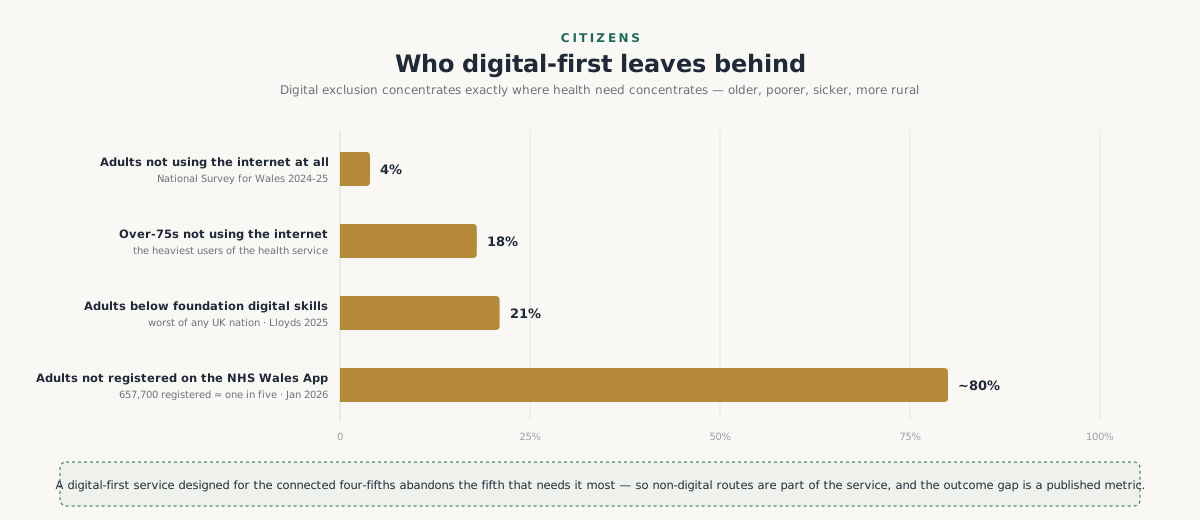
So the Digital Blueprint for NHS Wales treats non-digital routes as part of the service, not a legacy cost: assisted-digital provision procured with every citizen-facing service, partnership with Digital Communities Wales for skills and devices, and one hard metric on the national dashboard — outcomes for non-digital users tracked against digital users, published. If the gap grows, the service is failing, whatever its app-store rating.
Welsh is an invariant, not a toggle
Bilingual parity is already statutory; the blueprint makes it operational. Welsh-language clinical terminology maintained in the national terminology service. The Active Offer principle of More than just words implemented as design acceptance criteria — the service greets the citizen in their language, not after a settings hunt. Welsh-speaking participants in every round of user research as standard. And procurement specifications that make Welsh-language acceptance criteria pass/fail, so parity is priced in at tender, not bolted on at snag list. This site holds itself to the same bar: a Welsh edition of its core pages is on the roadmap.Sources for this page