On this page 8 sections
The Ask
One decision starts everything: commission the independent forensic review of national digital delivery, and open the Reform-the-Funder workstream in parallel. The decision-makers are the Cabinet Secretary for Health and Social Services (the review, by ministerial direction) and the Senedd Public Accounts Committee (the workstream, on its own authority). The window is the new Senedd term: programmes for government fund what is already worked out, and this Digital Blueprint for NHS Wales is the worked-out version. Cost of reform: £5–15M, one-off. First-year avoided waste: larger. The rest of this page is the case.
The Situation
Digital Health and Care Wales (DHCW) — NHS Wales’ national digital body — has grown its annual budget to ~£200M in 2025-26, with cumulative Welsh Government funding exceeding £600M over five years and £0.5M of quantified delivered value across the full period. That is 83p per £1,000 invested, and the rate has worsened year on year as headcount and budget have grown faster than delivery. Twelve months of Level 3 enhanced monitoring produced no de-escalation; in April 2026 DHCW was escalated further to Level 4 Targeted Intervention. At its March 2026 board, DHCW reported 45 of 47 Phase One milestones delivered under Level 3 — and was escalated to Level 4 regardless; 42% of IMRP milestones were on track at the September 2024 audit; £32.9M of DPIF revenue and £13.1M of capital remained unallocated. The cause is structural: 11 reinforcing feedback loops in two clusters, protected by seven of the eight system traps Meadows catalogued.
The Plan
Six structural interventions — five sequenced at DHCW, one parallel at Welsh Government — targeting Meadows’ leverage points 2-6 (system rules, information flows, self-organisation, goals, paradigm) rather than the shallow Levels 10-12 (headcount, reorganisation, strategy documents) where every prior fix has absorbed.
| # | Intervention | Leverage | Owner | Timeline | Addresses |
|---|---|---|---|---|---|
| 1 | Competent Leadership | L2 + L5 | Welsh Gov / Audit Wales | Months 0-6 | Cluster B self-preservation (L7, L8, L9, L10, L11); patient-safety triage; board reset; patronage pipeline disclosure |
| 2 | Radical Transparency | L6 | New leadership | Months 6-9 | L6 (manufactured narrative), L10 (information fortress); anti-sanitisation protocol; statutory publication |
| 3 | Portfolio Ruthlessness | L7 | Independent panel + new leadership | Months 6-18 | L1 (hiring trap), tragedy-of-the-commons; the stop list |
| 4 | Flip the Model | L5 + L4 + L3 | New leadership + health boards | Months 6-24 | L2 (credibility), L5 (vendor dependency); £1.25B contract recovery; standards-body endpoint |
| 5 | Break the Annual Trap | L5 | Welsh Gov | Months 6-18 | L3 (funding uncertainty); programme envelopes |
| 6 | Reform the Funder | L5 + L3 | Welsh Gov / Senedd PAC | Months 0-12 (parallel) | L3, L11; WG-as-co-conspirator; RAG honesty; capital-revenue coherence |
The five DHCW interventions (1-5) depend on Competent Leadership being complete first; interventions 2-5 run in parallel from Month 6. The sixth intervention — Reform the Funder — runs in parallel from Month 0, owned by Welsh Government and the Senedd Public Accounts Committee rather than DHCW. Without it, the same conditions that produced DHCW’s failure reproduce for any successor body.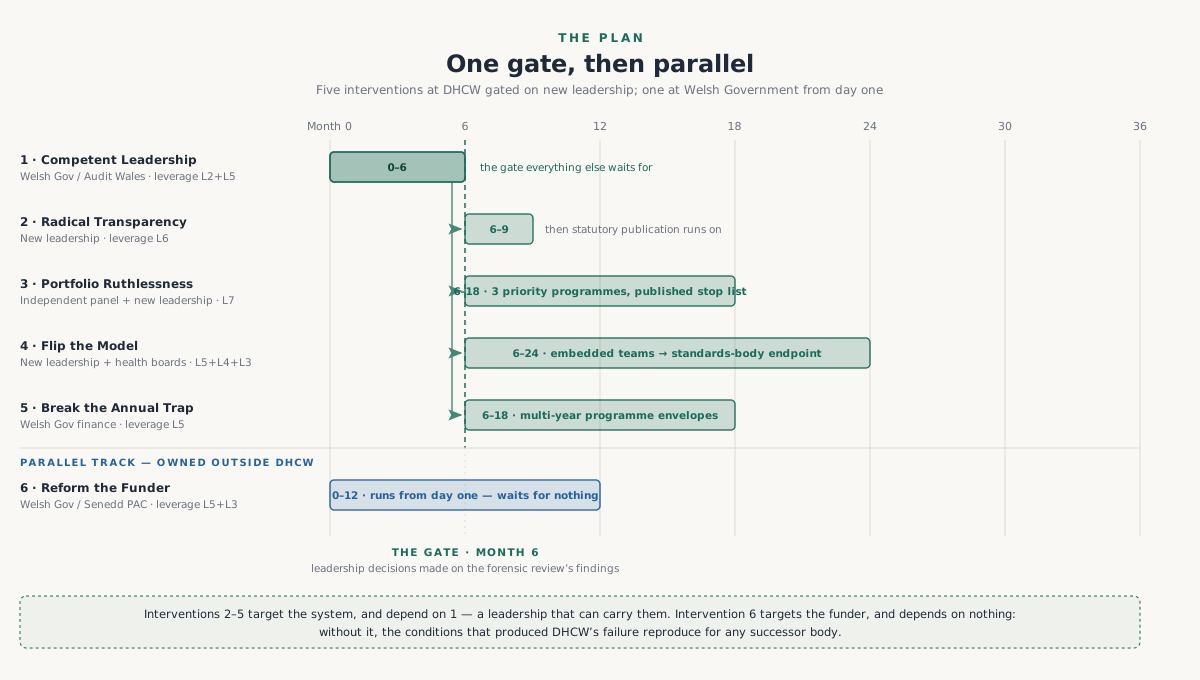
The 36-Month Timeline
- Months 0-3 — Independent forensic review commissioned. Patient safety triage of live national systems and shared infrastructure (WPAS, eMPI, WCCG, WICIS, RISP, PSBA-class infrastructure, and the data-centre estate). Audit Wales mandates data publication. Protected staff reporting channel established. Senedd PAC opens parallel Reform-the-Funder workstream (RAG audit trail, capital-and-revenue coherence rules, remit-letter discipline).
- Months 3-6 — Review findings delivered. Leadership change decisions made. Non-executive board audit complete; sub-committees reconstituted with technical NEDs.
- Months 6-12 — New leadership appointed. Transparency dashboard launched against statutory publication categories. Independent panel selects 3 priority programmes against patient-safety-weighted criteria; published stop list binding for 24 months. Two pilot health boards embedded. Vendor portfolio audit completed; sole-bidder contracts above £1M re-tendered or terminated.
- Months 12-24 — Focused programmes delivering. Embedded teams shipping. Genuine post-mortems on WCCIS and OpenEyes completed. Trust recovery begins.
- Months 24-36 — Embedded model scaled. Portfolio cautiously expanding on proven demand. Organisation identity transitioning from “national IT department” to a standards-and-interoperability body.
Full detail: the 36-month timeline.
The Economics
| Planned reform | Status quo | |
|---|---|---|
| Year 1 | £5-15M one-off investment | £100-150M direct DHCW waste |
| Year 2-5 | Cumulative £500M-£1B saved | Cumulative £500M-£1B wasted |
| Downstream NHS Wales (5y) | £3-10B saved | £3-10B cost |
| Patient harm | Halts adding to the ledger | Continues to accrue |
| Crisis risk | Contained | Near-certain crisis-forcing event |
| Reform cost | £5-15M | 2-3× once forced |
Break-even on the planned reform: in weeks, not months. Year-one direct DHCW waste (£100-150M) already exceeds the one-off reform cost by an order of magnitude.
The figures above are direct DHCW waste only. Every DHCW failure cascades outward to seven health boards and NHS Wales as a whole: clinician time lost to broken systems, patient-safety incidents, cross-border referrals, duplicated shadow IT. The downstream cost runs at 5-15× the direct figures — the derivation is shown here.
Total five-year impact across NHS Wales: £3-10 billion. £500M-£1B direct × a 5-15× downstream multiplier = £3-10B of total NHS Wales five-year cost in status quo, or savings under planned reform. Reform is not a DHCW-internal saving. It is an NHS-wide dividend on a scale comparable to a small acute trust’s annual budget — every year.
Patient harm is on a separate ledger. DHCW’s patient index (eMPI) has mixed up patient records in operational use; WCCG ran on vendor-unsupported technology for more than eight years. The Royal Colleges find that GPs and physicians “regularly see examples of patients experiencing delays … leading to deterioration or worsening health when they move between systems.” These entries cannot be undone by future reform. Every additional month of the status quo adds to a ledger that money cannot reverse.
Staff harm is on a parallel ledger. Burnout at 68.9% and rising; sickness days up 82% across three years against 30% headcount growth; both stripped from the published minutes as they occurred. The burnout record tells it in full; the numbers live at the facts page.
Full detail: the cost of inaction.
The Single Decision
Planned reform or crisis-forced reform. These are the only two options. The Welsh choice is the sequencing: now, at £100-150M/year direct DHCW waste plus a 5-15× multiple in downstream NHS Wales impact — or later, after a crisis-forcing event, at 2-3× the direct cost and an even larger downstream tax. Patient harm continues to accrue on a separate ledger that money cannot reverse, regardless of when reform happens; it just stops accruing sooner.
What does a crisis-forcing event look like? On the current trajectory: a PSBA-class shared infrastructure failure scaled beyond a single day’s outage; a documented patient-safety incident traced to a known-deferred remediation; an Audit Wales special report; sustained Senedd-led political escalation that forces unscheduled leadership departure. The PSBA outage of March 2026 — when O365, EPMA, RISP, and radiology went offline simultaneously across all NHS Wales — was a precursor, not the event itself.
For the Sceptical
- The international case: Alternatives — Denmark, Estonia, NHS Digital England built better digital health with competent leadership. The DHCW monopoly model is a Welsh-specific choice, not an industry norm.
- The systems-thinking case: Methodology — stocks, flows, loops, delays, traps. A forty-year discipline.
- The evidence: the public record — DHCW’s own board minutes, Audit Wales reports, Senedd proceedings, FOI material. The State of DHCW keeps the receipts: 89 numbered references, with 48 archived documents hosted on this site.
What You Can Do
- Read the diagnosis and the methodology — and test the argument against the evidence.
- Circulate this brief as a PDF: download it here.
- Use the analysis — it is offered freely for political, NHS, and public use, with attribution (how to cite).
The diagnosis is structural. The prescription is specific. The only missing ingredient is the political will to act.